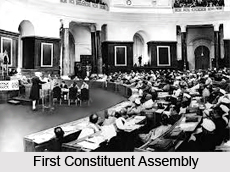
 A Constituent Assembly is a body composed for the purpose of drafting or adopting a Constitution. It played an important role in creating the Constitution of India. The Constituent Assembly of India was set up by the Indian leaders and members of the British Cabinet Mission. It was formed by the elected members of the provincial assemblies of India which was presided over by Dr. Sachidanand Sinha, who was the temporary chairman of the Assembly.
In the Constituent Assembly of India there were members from the Congress as well as from Muslim League. There were also members from the Scheduled Caste Federation, the Communist Party of India and Unionist party in the Constituent Assembly. The Constituent Assembly of India included sections of Christians, Anglo-Indians and Minority Community. The final Constituent Assembly of India had two hundred and seven representatives, including fifteen women. There were about ninety three members nominated from the princely states and The Congress secured a huge majority
The members of the Constituent Assembly of India were chosen by indirect election by the members of the Provincial Legislative Assemblies which was according to the recommendation of the Cabinet Mission. The Cabinet Missions stated that: There should be 292 members were elected through the Provincial Legislative Assemblies; 93 members represented the Indian Princely States; and 4 members represented the Chief Commissioners` Provinces. The total membership of the Assembly thus was to be 389.
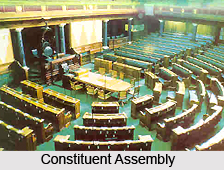 Dr. Rajendra Prasad became the President of the Assembly. Harendra Coomar Mookerjee was the Minority Community Chairman. . While H P Modi served as the representative of the Parsi community, Frank Anthony headed the Anglo-Indian section of the country in the Constituent Assembly. Quite a large number of female personalities were also present in the Constituent Assembly in India including Vijaylakshmi Pandit and Sarojini Naidu. Jawaharlal Nehru, C. Rajagopalachari, Sardar Vallabhbhai Patel, Maulana Abul Kalam Azad and Shyama Prasad Mukherjee were some important figures in the Assembly.
The members of the Constituent Assembly met for the first time in the year 1946 on December 9. On August 15, 1947, India became an independent nation, and the Constituent Assembly served as the first Parliament of India. The Constituent Assembly took almost three years to complete the task of drafting the Constitution for Independent India. During this period, it held eleven sessions. Various Committees were formed in the Constituent Assembly of India. Dr. B.R Ambedkar was the chairman of the drafting committee in the Constituent Assembly of India.
