The birth of Tansen is itself regarded a mythical legend. He was born in Behat, in Gwalior. Since boyhood, he was inclined to spiritual singing, and was a known ventriloquist of animal sounds. His unnatural genius was garnished by another legendary vocalist, Swami Haridas. Under him Tansen, gradually grew into a latent musical wonder, and his life thereafter in the court of Emperor Akbar is mythical and legendary, known to everybody. Due to Tansen`s marvellous vocal quality, he was literally snatched from Raja Ram Singh of Rewa by Akbar. However, various stories of Tansen`s feats are told, many of which do not have any evidential proof. Yet, the fact remains that a man like him cannot be compared with mere earthly parameters, because his hold over every genre of music and musical instrument possessed celestial quality. He had the capacity to captivate and beguile every listener and the Emperor would be overwhelmed each time he sang. Despite his gifted qualities, he was never short of humbleness and modesty with everybody he met. The more one speaks about him, the more does it turn into a legend.
No other name in North Indian classical music is as revered, and none`s memory as hallowed as that of Mian Tansen. Tansen`s recorded life is the stuff legends are made of. Historians cannot even assert the exact year of his birth or of his death. It has now become virtually impossible to separate the man from the saga, the artist from the myth. At least three commercial films have been produced dealing with Tansen`s life and musical career in detail or in passing. They all continue to perpetuate the myth of this singer of Orphic powers, this composer and creator on a colossal scale.
Chronicles do give a reasonably clear record of his early life and career. However, the events following his rise to fame at the court of Emperor Akbar are shrouded in myth and mystery. It is however known that he was born during the early part of the 16th century in a village called Behat, located about 7 miles from Gwalior. His father was a poet who belonged to the Gaudiya community. It is believed that he and his wife were childless for years and were blessed with a boy after they sought the blessings of a Sufi saint, Mohammed Ghouse. The boy was called by several names like Tanna and Ramtanu. One story goes that the boy was converted to Islam by choice after he was blessed by Peer Mohammed Ghouse. However, the name by which he is known today, Mian Tansen, was conferred as an honour on him by Maharaja Ram Niranjan Singh of Gwalior.
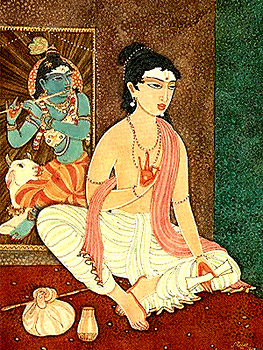
Legend again tells that the lad was an excellent ventriloquist of animal sounds. He was so adept at imitating the roar of a lion that he could scare away grazing animals as also human trespassers with his finesse. Some wandering mendicants of Vrindavan were so impressed by his talent that they advised him to learn music under the greatest dhrupad singer of his time, Swami Haridas of Vrindavan. And, for Swami Haridas music was an offering, a paean to God. It is said that once when Emperor Akbar, who rode all the way from Agra to Vrindavan to listen to this legend, requested Swami Haridas to sing for his pleasure, the saint refused stating that he could sing for none but his creator.
Swami Haridas, instinctively recognizing Tansen`s innate gifts, trained him rigorously in the art and science of dhrupad. It is said that Swami Haridas had mastered all the existing banis of dhrupad to perfection and trained different disciples in various banis, depending on the inclinations and gifts of each. Tanna, it is said, was trained in the Gauhar (or Gaud) bani. Some versions say that he served as a singer in the court of Man Singh Tomar for a while after spending a short time at Behat, his native village. Reputedly, his singing at the Shiva temple in his village is supposed to have set the tower of the temple vibrating. It was at the Gwalior court that he got married to one of Rani Mrignayani`s ladies-in-the-waiting, Husseini, and was converted to Islam. Another school of thought believes that Tansen received his initial training in dhrupad at the court of Man Singh Tomar, after which he moved to Vrindavan to study under Swami Haridas. In any event, the years with the latter proved to be the most momentous in his early life. What Swami Haridas, the magnanimous guru, gave him was not the mastery over a system of music, but a profound aesthetic founded on the sublime philosophy of Bhakti.
He served as a singer in the court of Maharaja Ram Niranjan Singh of Gwalior and then moved on to the court of Raja Ram Singh of Rewa. Both Ram Singh and Tansen were to share a deep friendship based on mutual love and admiration. His prowess as a singer soon reached the ears of Emperor Akbar who requested Ram Singh, through his emissaries, to despatch Tansen to the imperial darbar. Left with no choice, the king obeyed the royal diktat reluctantly and with much sorrow. Tansen was soon to become the Emperor`s favourite and was elevated as one of the Nine Gems in the regal court. At Fatehpur Sikri, there is a seat, exclusively made for the court favourite, located at the centre of a once-beautiful pond next to the Emperor`s chambers. It is also reputed that there existed a deep bond between the Emperor and the singer.
It was in the court of Akbar that he created some of the greatest raagas in Hindustani music, like Mian ki Todi, Mian ki Sarang, Mian Malhar and Darbari Kanada. Whether Tansen really created them or whether he modified the existing versions of Todi, Sarang, Malhar and Kanada is open to debate. Yet the perennial popularity of these raagas would make one believe that Tansen, the myth and person, contributed significantly to the dissemination of these raagas in all forms of North Indian music, as also giving them that distinct and unmatched stamp of genius. Numerous raagas have been created since then, but none possess the inimitable magic, the celestial grandeur, so characteristic of these raagas, especially when they are sung by dhrupad singers or performed by beenkars of high calibre.
Tansen also wrote and sang a number of compositions glorifying his patron, as was the order of the day. In the process, it is said that he drifted away from the spiritual moorings inculcated in him by his guru. Once the Gosain Maharaja, after a superb recital, gifted Tansen with 1000 gold mohurs and then placed a cowrie (a coin of low denomination made of shell) on top of the pile. He explained that the mohurs were for the peerless Tansen and the paltry cowrie for his God whom he had chosen to forget. The event opened the eyes of the misled genius and thereafter he composed numerous dhrupads and stutis (hymns) in praise of various Hindu deities which are revered to this day for their dignity, freshness and effulgence. Such was the fervour inherent in these compositions that the Maharaja himself, convinced of the transformation, allowed Tansen to offer worship in the Vallabhpathi temples, which were only open to Hindus. His compositions are sung to this day in the temples around this region.
Legends also say that when Baiju Bawra, another equally gifted disciple of Swami Haridas, came to Agra, he was forbidden to sing openly as it was the privilege of the singers of the royal darbar to do so. Infuriated, Baiju openly sang through the streets of Agra, amazing all who heard him. He was arrested and brought before the Emperor. On being questioned about his reasons for disobeying the regal pronouncement, Baiju stoutly defended the artists`s liberty for self-expression. When challenged to prove his abilities before his guru-bhai, Tansen, he readily agreed to the musical duel. What ensued is the stuff that legends are made of. Thunder clashed with thunder, lightning with lightning, torrent with torrent, and tempest with tempest in the imperial darbar. However, there is no evidence to speak about who won this astounding marvel. Opinion was deeply divided. Baiju left the darbar a free man after having asserted his liberty and proved his unshackled genius.
Tansen always remained a sincere pupil and devotee of his guru. Once, overcome by Tansen`s extraordinary recital, the Emperor told him that he was a peerless singer among the mortals. Tansen, in all humility, it would be profanation to nod to the royal compliment since one superior to him, his guru, lived and sang for his God by the banks of Yamuna. Incited by intense curiosity, the Emperor, accompanied by Tansen, rode to Vrindavan to listen to the celestial singer. However, the Swami refused to sing for the Emperor`s pleasure. But, Tansen devised a cunning strategy to get his guru to sing. The illustrious pupil sang in the presence of his guru and deliberately blundered, compelling the concerned preceptor to burst into song. The Emperor, going by the stratagem, had hidden himself behind a clump of trees and heard the heavenly music of the saint-singer. On their return to the court, Akbar requested Tansen to sing the way his guru did, but Tansen confessed honestly, `My guru sings only for his God; how can I, who sings to please his master, have that divine gift!` The unbridgeable differences between sacred and secular art are clearly illustrated through this story.
Tansen, in the meantime, taught music to all his children, including his daughter, Saraswati ( significant break with the rigidly maintained gender hierarchies of his time). Dhrupad gharanas, especially the
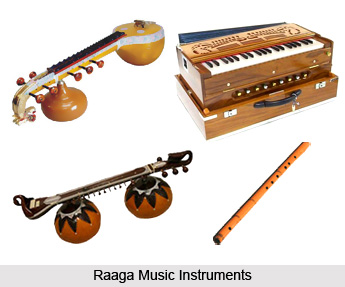
rudra veena players, of various hues and shades trace their origins back to the lineage of Tansen. To his daugher, aptly named Saraswati, he taught the art of transposing dhrupad music onto the rudra veena. He married his daughter to Misri Singh, the son of a Rajput ruler, and student of Swami Haridas, who preferred to die in the battle than kneel before Akbar. Misri Singh was a proficient beenkar (rudra veena player) who, when captured and brought to Agra, refused to even touch his beloved instrument despite pleas from the Emperor himself. But soon he was won over by Tansen`s deep love for him as also by the senior musician`s extraordinary capabilities. Soon the two were performing jugalbandis together. The result of the marriage between Misri Singh and Saraswati was an illustrious line of beenkars, and in later centuries, singers like the pioneers of khayal, Sadarang and Adarang. Most beenkars trace their musical lineage to this renowned woman.
To his sons, Bilas Khan, Surat Sen, Sarat Sen and Tarang Sen, he taught other stringed instruments like the rabab. The Senia Beenkar gharana of later years, initiated by Amrit Sen and his brothers in the court of Jaipur, traces its lineage to one or the other of Tansen`s children. The Senia gharana, while largely confined to the sitar, sarod and surbahar, remains to this day a mode of rendition. Many dhrupad singers trace their origin to Tansen`s sons. In any event, Tansen`s legacy is alive and with everybody in different forms and modes.
Perhaps it is only once in a century that one comes across a Titanic musical genius who combines the intuitive gifts of a fabulous artist with the cerebral powers of a profound theoretician. Records say that Tansen, who systematized the chaotic jumble of Hindustani music from the point of view of a judicious performer. He excised the redundant and retained the vital. It was during his time that dhrupad attained its fullest maturity. It was he who did much to perfect and popularize this form. As a pedagogue par excellence, he left behind numerous couplets and pointers illustrating various subtle aspects of music. Some of these may have been composed by the master himself, the rest may be attributions. Like Thyagaraja, he too penned a numer of Naadopasana or Naad Mahima compositions where he, self-reflexively eulogises various aspects of music in memorable ways. These are sung by several dhrupad singers and some khayal singers even today.
The aging Tansen wished to settle down in Gwalior during his last days. But whether he died in 1589 at Agra or Gwalior is not clear. It is said that the Badshah himself was by his bedside during his last hours and was torn with grief when his beloved court singer passed away. Music and joy, he said, vanished from his life after Tansen`s death. As with his birth, life and career, Tansen`s death too became stuff of legends in the manner of a true hero. When his son Bilas Khan, who was away from his father`s bedside at the time of his death, heard the news, he was plunged into deep sorrow. He gave vent to his profound grief on seeing his father`s lifeless body by bursting into an anguished song in Bilaskhani Todi, a raaga that came to be named after him. To add myth to myth, it is even said that the lifeless hand of his dead father rose for a moment as though to bless his worth son. His body was buried near the tomb of his first preceptor, Peer Mohammed Ghouse, whom he revered all his life. The legendary tamarind tree that shades his dargah is reputed to possess magical properties.
Tansen`s tomb, with the passage of time, became a neglected and decrepit monument, until Pt. Vishnu Narayan Bhatkhande made strenuous efforts to restore it to its former glory. Pained beyond words, he did all he could to restore the tomb to the level of a monument. More importantly, it was through Pt. Bhatkhande`s relentless efforts that the Tansen Sangeet Samaroh was initiated and continues to be held to this day in Gwalior. The musical community undertakes this annual musical pilgrimage to pay homage to their Grand Sire through sangeet aradhana (musical offerings).