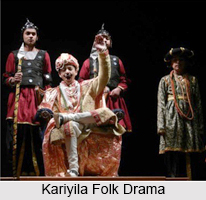
Mythological plays are based on themes from the Sanskrit epics and other Hindu and Buddhist mythology. Most Indian languages witnessed an abundant growth of plays based on these themes. This was done in the later part of the nineteenth century when modern theatre and drama were in their formative stage. These are popularly known as mythological plays but by the end of the century they became accepted as a critical category. It was useful for the modern Indian critic to differentiate the corpus of drama based on mythological episodes and characters from that based on history or contemporary life. Mythological plays, operating within mythic time, dealt with characters and situations recorded in ancient stories. Particularly it dealt in the two Sanskrit epics, the Ramayana and the Mahabharata and the Indian Puranas.
Another distinguishing feature of the majority of these plays is the dominance of devotion. They also incorporated several elements of traditional religious performances, particularly the music. This played an extremely important role in the emergence and popularization of this genre. In these respects they relate to traditional forms such as the varieties of Lila dealing with the lives of Rama and Krishna. For instance, the Ankiya Nat can be called mythological drama. However, the nineteenth-century plays based on myths did not grow purely out of such ancient traditions. They were constructed on European or Sanskrit dramaturgical principles, like the historical drama or social plays of the period.
A considerably large number of the scripts contained full-blooded projection of human characters and predicaments. They centre on interesting episodes in the lives of famous mythical heroes and heroines, such as Rama, Bhishma, Arjuna, Kama, Sita, Savitri, or Damayanti. They had attained archetypal dimensions in the Indian consciousness. In this respect Indian mythological theatre resembled Greek tragedy, in which playwrights constructed and interpreted myths in their own ways. However, it showed remarkable uniformity in approaches to themes and characters. The most popular stories were those of romance and love such as the marriage of Subhadra, or of Usha and Aniruddha, etc. Some of the moral questions such as the game of dice in the Mahabharata, young Abhimanyu`s death in an unfair battle, or Kama`s struggle against destiny, and the trials of women i.e. the stripping of Draupadi or Sita`s banishment were also equallt important. The sufferings of Harishchandra for his allegiance to truth inspired many authors, including Bharatendu Harishchandra in Hindi, Veeresalingam in Telugu, and Lilaramsingh Lalwani in Sindhi.
Nearly all the major Indian dramatists experimented with mythological themes and achieved popularity in varying degrees. Girish Chandra Ghosh, Rabindranath Tagore, and Kshirod Prasad Vidyavinod in Bengali, Krishnaji Prabhakar Khadilkar, Ram Ganesh Gadkari, and N. C. Kelkar in Marathi, are notable examples. Chilakamarthi Lakshminarasimham`s Gayopakhyanamu i.e. `The Gaya Episode` in 1889 in Telugu language sold in thousands. The potentiality of the genre was fully utilized by twentieth-century writers, who infused in it topical meanings and new significance. Khadilkar`s Kichakavadh i.e. `Killing of Kichaka` in 1907 was a landmark, the first successful attempt towards the politicization of mythological drama. This led to a ban by the British authorities. He identified Draupadi with India and Lord Curzon with the villain Kichaka who tried to molest her. Manmatha Ray`s Karagar i.e. `Prison` in 1930 in Bengali also used myth as political allegory. This play associated Krishna`s evil uncle, Kamsa, with the British rulers.
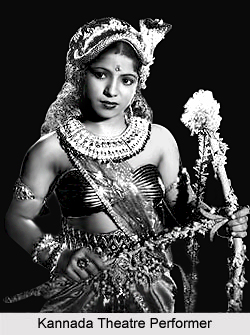
The Bengali plays Sita, by Jogesh Chaudhuri created stage history in 1924 because of the portrayal of Rama by legendary actor Sisir Bhaduri. Bhaduri represented the psychological state of the mortal lover denuding Rama of his divinity but still clothed in epic attire. In 1929 B. M. Srikantiah based Asvatthaman, considered a milestone in Kannada literature, on Asvatthama`s tragic life, but took its subtext from Sophocles`s Ajax. This highly controversial play was not only a fine instance of bold appropriation of both Hindu and Greek mythology but also of the total secularization of mythological drama.
The genre did not fade away after India`s independence. On the contrary, important playwrights applied it to interpret contemporary concerns. Dharamvir Bharati`s powerful Hindi verse drama Andhayug i.e. `Blind Age` in 1954 was based on the Kurukshetra war and the moral degeneration it brought about. Again Buddhadeva Bose`s Tapaswi o Tarangini i.e. `Tarangini and the Ascetic` in 1966 was very important. In that play he uses an episode from the Ramayana celebrating the power and beauty of sex. These two dramas are two eloquent examples.