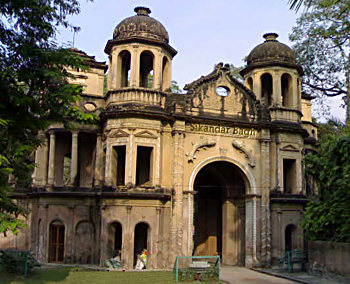
British military architecture in India under English domination was an extraordinary theme, which grew by every year. The guiding factor was hostilities in relationships amongst Indians and Britons, as time passed. For example, things were not the same in the phase of 20th century, as it was in the early 18th century. Quite naturally Englishmen needed to safeguard themselves by fortifications. To accomplish such factors, bastions, fortress started coming up. Post-death military monuments were also an overriding factor during British rule in India.
As the British East India Company`s military forces increased in size and as more wars ensued, monuments devoted to the military far outnumbered all others. Frequently executed in memory of a particular slain officer, it was common for them to be funded by fellow officers. The visual theme of grief predominated and rarely did they possess a visual sense of India.
A second theme regarding the British military monuments in India during this period addressed the factor of group death. In St. John`s Church, Calcutta, a monument is dedicated to the memory of Captain Charles Lionel Showers and his two lieutenants who died in 1814 while leading a charge of the Bengal Infantry during the Nepal War of 1814-16. In another work, Robert William Siever executed a relief to four captains, a lieutenant and a physician who had died of fever in the course of the First Burma War of 1824-26. It is located in St. John`s Church, Madras.
Holwell Monument
Holwell Monument, Kolkata is closely related to the dark history of India. The Black Hole of Calcutta was a small prison in the old Fort William in Calcutta, established by the Britions, where troops of Siraj ud-Daulah, the Nawab of Bengal held British prisoners of war after the capture of the fort on 20 June 1756. One of the prisoners, John Zephaniah Holwell, claimed that following the fall of the fort, British and Anglo-Indian soldiers and civilians were held overnight in conditions so cramped that many died from suffocation, heat exhaustion and crushing. He also claimed that 123 prisoners died out of 146 held. However, the precise number of deaths, and the accuracy of Holwell`s claims, has been the subject of controversy. The commander of garrision organized an escape, leaving behind 146 mercenary soldiers under the command of John Zephaniah Holwell, a senior East India Company public servant who had been a military surgeon. However, desertions by allied troops made even this impermanent defense ineffectual, and the fort fell on 20 June. The surviving defenders, who numbered between 64 and 69, were captured along with an unknown number of Anglo-Indian soldiers and civilians who had been sheltering in the fort. At that time some prisoners were able to escape.
Barrackpore Cantonment
 Hooghly River has the distinction of being the oldest in the country. Barrackpore Cantonment came into being in 1772 and remained the symbolic seat of military power until the capital of British East India Company and the later the British Parliamentary Government was shifted from Kolkata to New Delhi. Barrackpore Cantonment has a rich legacy of events pertaining to the Sepoy Mutiny of 1857. The ramifications were felt in the entire British Government. The Sepoys of 47th Native Infantry rebelled against the orders of the English military officers to move to Chittagong and to Rangoon under the leadership of Sepoy Bindi Tiwaree.
Cellular Jail
Cellular Jail, was a British colonial prison situated in the Andaman and Nicobar Islands. The prison was used by the British especially to exile political prisoners to the remote archipelago. Many notable nonconformists such as Batukeshwar Dutt and Veer Savarkar, among others, were imprisoned here during the struggle for India`s independence. The construction of Cellular Jail started in 1896 and was completed in 1906. The original building of Cellular Jail was a puce-colored brick building. The bricks used to build the building were brought from Burma. The building had seven wings, at the centre of which a tower served as the intersection and was used by guards to keep watch on the inmates. The wings radiated from the tower in straight lines, much like the spokes of a bicycle wheel. A large bell was kept in the tower to raise the alarm in any eventuality. Each of the seven wings had three stories upon completion. There were no dormitories and a total of 693 cells.
Fort William
Fort William is a masterpiece of British architecture in Kolkata. Situated at the banks of river Hooghly, it was named after King William III of England. Fort William of Kolkata was established during the possession of British Raj from 1696. It was the guardroom of this two-storied building, where the black hole tragedy took place. During the Battle of Plassey in 1757, Siraj Ud Daulah, the Nawab of Bengal attacked on the fort and defeated the Britons. This paved way for the construction of a new fort by British. The new fort was initiated by Robert Clive, which got completed by 1780. The basic purpose of setting up Fort William was to prevent attacks from Muslim Sultans.
India Gate
India Gate, originally called the All India War Memorial, is a war memorial located astride the Rajpath (Delhi), on the eastern edge of the `Ceremonial Axis` of New Delhi, formerly called Kingsway. The names of some 70,000 Indian soldiers who died in World War I, between 1914-19, are inscribed on the memorial arch. In addition, the war memorial bears the names of some 12,516 Indian soldiers who died while serving in the Northwest Frontier and in the Third Afghan War.
World War I Memorial of Tiruchirappalli
World War I Memorial, located opposite to Gandhi Market, Tiruchirappalli in the state of Tamil Nadu, This war Memorial is war memorial dedicated for the soldiers of Trichinopoly. The memorial which was also popularly known as "Clock Tower" was languishing without much maintenance.