Tolkappiyam, Indian Literary Text - Informative & researched article on Tolkappiyam, Indian Literary Text
  Indianetzone: Largest Free Encyclopedia of India with thousand of articles Indian Literature


in  
Art & Culture | Entertainment | Health | Reference | Sports | Society | Travel
Forum  | RSS Feeds  | Free E-magazine
Indian Literature : Indian Literature l History of Indian Literature l Sanskrit Literature l English Literature in India l Regional Indian Literature l Indian comics l Indian Poetry l Indian Literary Personalities l Indian Epic Poetry l Renaissance in Indian Literature l Indian Novels l Indian Literary Organisations l Indian Literary Movements l Contemporary Indian Literature l Medieval Indian Literature l Ancient Indian Literature l Themes In Indian Literature l Genres in Indian Literature l Influencing Factors On Indian Literature l Forms of Indian Literature l Religious Influence on Indian Literature l Modern Indian Literature
Home > Reference > Indian Literature > Regional Indian Literature > Tamil Literature > Tolkappiyam
Tolkappiyam, Indian Literary Text
Tolkappiyam is an ancient Tamil Grammar text.

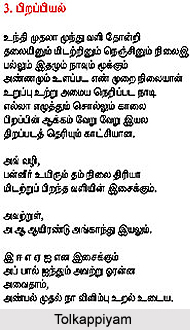
Tolkappiyam, Indian Literary TextTolkappiyam is the most ancient Tamil grammar, ascribed to a poet called Tolkappiyar of the first century BC, and of great importance in tracing the history of Tamil theatre. It contains three chapters, of which the one on pond has a section called meyppattiyal. This chapter deals with eight emotions that could be built up in the body and mind. Each of these emotions has four different aesthetic appeals. From them, we can therefore derive thirty-two different expressions. This is the section most relevant to performers in dance and theatre.

The eight emotions are nakai i.e. humour, azhukai i.e. sorrow, ilivaral i.e. satire, marutkai i.e. innocent confusion, accam i.e. fear, perumitam i.e. pride, vekuli i.e. anger, and uvakai i.e. joy. Scholars have compared them to the eight rasas of Sanskrit aesthetics. The ninth, santa rasa, of stillness and calm, which may have evolved in later classical times, is not mentioned as a separate meyppattu i.e. `physicalization of feeling` in this work. The emotions are also conventionally classified according to the aintinai, the five ecological zones into which Tamils divided their landscape. Tolkappiyar`s formula suggests that only persons with precise sensibilities of the eye and ear could receive these emotions. This section helps in actors` training.

This article is a stub. You can enrich by adding more information to it. Send your Write Up to content@indianetzone.com

(Last Updated on : 8/08/2009)
  More on Tamil Literature...
 
Subramaniam Bharati Subrahmanya Bharathi Vedanayagam Pillai
Dr U.Ve. Swaminatha Iyer Kamban Medieval Tamil Literature
Purananuru- Sangam Literary Work of India Ahananuru- Sangam Literary Work of India Tiruvalluvar
Sangam Literature of Tamil Nadu Ottakuttar Tolkappiyam
Sekkizhar Musicological Literature of South India Chintamani
Kural Sangam Age in Tamil Literature Post-Sangam Age in Tamil literature
Vijayanagar and Nayak Age in Tamil Literature Modern Era in Tamil literature  
Recently Updated Articles in Indian Literature
  • Arunagirinathar
    Arunagirinathar was a great Tamil poet, who was born in Tiruvannamalai during the reign of Praudha Devaraya II.
  •  
  • Geeta Gobinda
    Geeta Gobinda is a poem composed by the famous poet Jayadeva. The poem depicts the feeling of intense love of Krishna and Radha and also brings forth the devotion towards Lord Vishnu.
  •  
  • Jayadeva
    Jayadeva was a famous Sanskrit poet of the 12th century who had popularized the love of Radha and Lord Krishna.
  •  
  • Tulsidas
    Tulsidas was a great poet, philosopher, saint and, more importantly, the devotee of Lord Rama.
  •  
E-mail this Article | Post a Comment
Free E-magazine
Subscribe to Free
E-Magazine on Indian Literature

 
Tolkappiyam, Indian Literary Text - Informative & researched article on Tolkappiyam, Indian Literary Text
Sitemap
Contact Us   |   RSS Feeds
Copyright © 2008 Jupiter Infomedia Pvt. Ltd. All rights reserved including the right to reproduce the contents in whole or in part in any form or medium without the express written permission of Jupiter Infomedia Pvt. Ltd.