


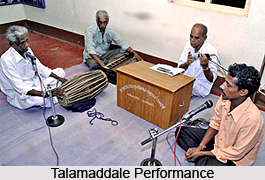
 Talamaddale is derived from the term 'tala' which means cymbal and 'maddale' i.e. the Yakshagana drum. This is a variant of the Kannada theatre form of Yakshagana. This is quite popular in the western districts of Karnataka. Essentially, it presents Yakshagana with songs and dialogue but without dances and stagecraft. Talamaddale is derived from the term 'tala' which means cymbal and 'maddale' i.e. the Yakshagana drum. This is a variant of the Kannada theatre form of Yakshagana. This is quite popular in the western districts of Karnataka. Essentially, it presents Yakshagana with songs and dialogue but without dances and stagecraft.
History of Talamaddale Historically, it seems to have originated before Yakshagana but continued to retain a separate identity and stronghold even after the latter gained popularity. Performance of Talamaddale The performance takes place in any common indoor space where the singers, instrumentalists, and actors sit in a prominent spot and the audience in the rest of the area. These shows are not ticketed, the modest expenses being shared by the patrons or the local community. As in Yakshagana, the Bhagavata i.e. the main singer is the key person. He introduces the plot, beginning with an invocation and minimal preliminaries. Then the actors, all in a squatting posture, one by one assume their respective roles. Each of them gives a long introduction to his character, contextualizing it in the Puranic panorama and locating it in the episode of the day. Through extempore dialogue and rhetorical speech, the performance develops into a lively battle of wits where the actors interrogate one another, extensively quoting from the epics. They also take the plot to its climax. The structure juxtaposes two seemingly disparate matrices, the mythic-epic and the contemporary. The songs narrates epic events while the dialogues are free-floating, often venturing into contemporary socio-political allusions. As Talamaddale relies solely on songs and dialogue, every actor needs to have a good voice, a capacity to blend musical delivery with witty speech, and a thorough knowledge of the epics and the specific episodes. These qualifications combined with an impressive stage presence make a star performer. Talamaddale's wide popularity complements that of Yakshagana, both forms influencing and sustaining each other. Popularity of Talamaddale The reasons for Talamaddale's popularity are twofold. Talamaddale provides occasion to relish exclusively the intricacies of the song and prose components of Yakshagana without the distractions of stagecraft. Secondly, it is a way of capitalizing on the enthusiasm for Yakshagana during the off-season when open-air shows are not possible. Therefore, Talamaddale sessions abound during the monsoon i.e. from June to October. However, amateurs often continue performing throughout the year and, occasionally, professional Yakshagana artists are invited to join as well. Popular Talamaddale Artists Some of the popular Talamaddale artists are Sheni Gopala Krishna Bhat, Kerekai Krishna Bhat, Kerekai Umakant Bhat, Polali Shankaranarayana Shastri, Shankaranarayana Samaga, Vasudeva Samaga, and Prabhakara Joshi to name a few. |
| |||



Home > Movies & Entertainment > Indian Drama & Theatre > Forms of Indian theatre > Classical Indian Dance Drama > Talamaddale
Talamaddale
| Talamaddale is the variant of the Kannada theatre form of Yakshagana. |
| ||||||||||||||||||||||||||||

