


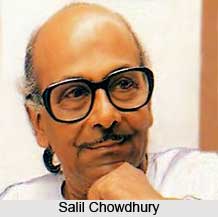
 Salil Chowdhury was popular for his indigenous style of music. He combined the strains of Western classical with Indian folk and classical music to give Hindi cinema some of its most popular melodies. Born in November 19, 1922, Salil Chowdhury spent much of his early childhood days in Assam. His father was a medical doctor. In 1944 Salil Chowdhury came to Kolkatato complete his graduation from Bangabasi College under Calcutta University. Salil Chowdhury did not receive formal training in music. Instead he grew up listening to Bach, Mozart, and Chopin, as well as eastern Indian folk music. As a young man he was drawn by the communist ideology and he joined the leftist Indian Peoples' Theatre Association (IPTA). It was here that he began composing music for plays. Salil Chowdhury was popular for his indigenous style of music. He combined the strains of Western classical with Indian folk and classical music to give Hindi cinema some of its most popular melodies. Born in November 19, 1922, Salil Chowdhury spent much of his early childhood days in Assam. His father was a medical doctor. In 1944 Salil Chowdhury came to Kolkatato complete his graduation from Bangabasi College under Calcutta University. Salil Chowdhury did not receive formal training in music. Instead he grew up listening to Bach, Mozart, and Chopin, as well as eastern Indian folk music. As a young man he was drawn by the communist ideology and he joined the leftist Indian Peoples' Theatre Association (IPTA). It was here that he began composing music for plays.
Career of Salil Chowdhury Salil Chowdhury made his foray into Indian film music with Satyen Bose's Bengali feature 'Paribartan.' He co-wrote the lyrics for Bose's next film too. His first Hindi assignment came with Bimal Roy's 'Do Bigha Zameen' for which he also wrote the story. His extensive use of chorus in the song 'Hariyala Sawan Dhol Bajaata Aaya' and 'Bhai Re, Ganga Aur Jamuna Ki Dharti' were reminiscent of his earlier work for IPTA.  Salil Chowdhury's music for subsequent film such as 'Biraj Bahu', 'Naukri', and 'Jagte Raho' became extremely popular. His biggest success, however, once again came with Bimal Roy's 'Madhumati.' The film's songs, from the romantic 'Dil Tadap Tadap Ke' to the cheerful 'Jungle Mein Mor Naacha' to the haunting 'Aaja Re Pardesi', prove the composer's versatility. The film's music regarded as one of Hindi cinema's classics, won Salil Choudhury the Filmfare Award for Best Music Director in 1958.
One of the characteristic features of Salil Chowdhury's music was his adaptation of the Western classical music. For instance, the Talat Mahmood's hit 'Itna Na Mujhse Tu Pyar Kar' (Chhaya) is said to be based on a well-known Mozart composition. Later, in the 1970s, he adapted the jazz structure to come up with such touching numbers as 'Zindagi Kaisi Hain Paheli' (Anand) and Na Jaane Kyon (Chhoti Si Baat). Due to Salil Chowdhury's expertise in orchestration and mood music, directors often called upon him to compose the background score for films without songs, such as Ittefaq. Chowdhury was also the only major Hindi film composer to have worked in several languages, including Assamese, Tamil, Telugu, and most importantly, Malayalam, with Chemmeen being a remarkable success. He also directed Pinjre Ka Panchi in 1966. Salil Chowdhury had married Smt. Sabita Chowdhury. He has two daughters and two sons. He died in September 5, 1995(1995-09-05). Music Compositions of Salil Chowdhury
|
| |||



Salil Chowdhury
| Salil Chowdhury enriched Bollywood music with his style that combined Western classical with Indian folk and classical. |
| ||||||||||||||||||||||||||||

