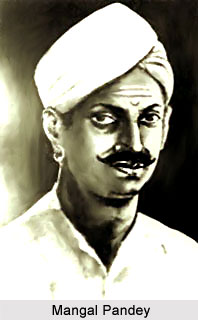
 Mangal Pandey at the age of 22 entered the British East India Company Bengal Army in 1849. The role of Mangal Pandey in the British regiment was that of a sepoy (soldier) in the 34th Regiment of the Bengal Native Infantry (BNI). He was a tall lad, lean and well built. Mangal was part of the 5th Company of the 34th BNI regiment, famously acknowledged as fearsome attacking officers. The Company is known to have contributed immensely in what came to be known as the Sepoy Mutiny and the Great Revolt of 1857. The peasants recruited by the East India Company as sepoys (soldiers) were mostly unusually tall-so much so that during the 1857 war, Scot Highlanders was brought over especially from Britain to match sepoy strength and height. Local perceptions played a great part in victory or defeat-the natives considered sepoys invincible.
Mangal Pandey had gone to Akbarpur for some work. There he chanced upon talks of a sepoy (soldier) detachment marching along the Grand Trunk Road towards Benaras. Mangal reached Kanpur and looked at the impressive parade. Built by Sher Shah Suri and extended by Akbar in the sixteenth century, the Grand Trunk Road ran from Peshawar to Calcutta. It connected the north-west and the east. In 1857 its vital, strategic importance became a major bone of contention between the British and the sepoys.
 Mangal was enlisted even as he stood looking at the parade. The tendency to enlist curious onlookers was rampant, as recruiters usually followed the army. Mangal had no time to rush to Surhurpur to consult his father or Nakki Khan, his boyhood friend, who had become a serious religious scholar. He gave his consent and was admitted. Pandey was asked to report a couple of days later in Allahabad.
Finally when Mangal Pandey`s decision did reach the village, Divakar Pandey was indifferent to it, but Nakki Khan was furious. The latter`s father was dead and Nakki now led the namaz (literally standing for `to bow and prostrate`, the Islamic significance of namaz is a ritualistic prayer practiced by Muslims by invoking Allah) in the local mosque. The friends had a falling out. For Mangal however, the issue was not that he was joining a British army. He saw the move as vital for his growth and career prospects.
In the barracks, Mangal came to be known what was increasingly being referred to as the `new sepoy`. The 1850s were Lord Dalhousie years, when the impatient governor general, whose policies like the Doctrine of Lapse led directly to the 1857 happenings. The doctrine was exceedingly tightening to the hapless victims of the law. However, East India Company and British officialdom regarded it as a slackening of discipline.
Mangal Pandey later lost his admiration and respect for the British East India Company due to its gruesome and cruel actions inflicted upon the Indians.