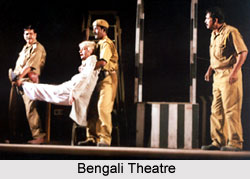
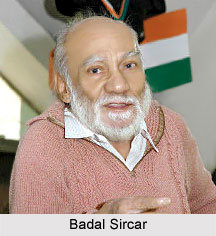
 Badal Sircar was the famous Bengali dramatist who is known as the innovator of contemporary Indian theatre. He was a popular name in Bengali theatre and is popular for his anti establishment plays during the Naxal Movement in Kolkata. He is the proud recipient of Padma Shri, Sangeet Natak Akademi Award and Padma Bhushan, among others.
Early Life of Badal Sircar
He was born on 15th July in the year 1925. He was admitted to Scottish Church College under University of Calcutta and later got transferred to Bengal Engineering College, Shibpur, then affiliated with the University of Calcutta for civil engineering course. He completed his Master of Arts degree in comparative literature from Jadavpur University in Kolkata.
Career of Badal Sircar
From his childhood only he took a keen interest in theatre but did not give up his employment with various engineering and town planning organizations in India and abroad until 1975. Dismayed by the paucity of good Bengali theatre, he began writing plays in the 1950s. He soon found he had flair for comedy and for catching the cadence, wit, and everyday speech of middle-class Kolkata. His early comedies have a flavour unique in Bengali literature.
Badal Sircar wrote his first serious play, Evam Indmjit, in 1963. Its publication and premiere in 1965 attracted wide notice for its striking originality and themes of absurdist meaninglessness, identity crisis, and social conformity. It is perhaps the one contemporary Bengali drama most translated into other Indian languages. While working in Nigeria, Sircar authored in quick succession several plays which secured his reputation. Some of the names can be mentioned as Baki itihas or "Remaining History" in 1965, Pralap i.e. "Delirium" in 1966, Tringsha shatabdi i.e. `Thirtieth Century` in 1966, and Pagla ghora or `Mad Horse` in 1967. All of these were premiered by Bohurupee, followed by Shesh nei i.e. "There`s No End" in 1969. His concern was the pointlessness of existence, compounded by a sense of associative guilt and responsibility in disturbed persons. These persons belong to the urban middle class in a world of increasing violence and inhumanity.
Badal Sircar`s part in theatre was not confined to playwriting. He grew more interested in production, and formed his group Satabdi in 1967. It soon became inactive. The experience set him thinking about the failure of Bengali theatre i.e. commercial theatre, group theatre, and Jatra. He wanted to achieve its true purpose. This led him to conceptualize what he called anganmancha or Third Theatre. In 1969 he reorganized Satabdi. At first he directed his earlier plays on proscenium stages. But some changes happened after Sagina Mahato in 1970 that he dramatized from Gaurkishor Ghosh`s novel and Abu Hosain in 197, which was adapted from Girish Ghosh`s play. He brought changes in style and new technique germinating his new ideas. He finally abandoned the proscenium and produced the revolutionary Spartacus in 1972 in an almost bare room with spectators sitting all around.
He followed with Michhil i.e. Procession, Bhotna in 1976, Basi khabar i.e. Stale News in 1979 and also many other plays. They were enacted not only in hired rooms but as open-air shows in city parks and villages, expressions of his conviction that theatre had to break the barriers between performer and spectator, performer and performer, spectator and spectator. According to him theatre must be a collective exercise to awaken and enhance the social consciousness of participants, who include the viewers. Another principal aim was to break the urban and rural divide. He wanted and achieved the involvement of villagers among whom he lived during the process of some plays in writing and production. In the late 1980s Satabdi went further in Sircar`s untiring pursuit to raise the level of awareness by touring widely in Bengal`s countryside. Badal Sircar was equally determined to free theatre from the monetary linkage and divisive transaction of ticket sales. He decided to rely only on voluntary donations from the audience. In a rare appearance on screen, he acted in the experimental film Kal abhirati i.e. "Time Addiction" in 1989.
Awards Received by Badal Sircar
Government of India awarded Sarkar the Padma Shri in 1972, Sangeet Natak Akademi Award in 1968 and the Sangeet Natak Akademi Fellowship- Ratna Sadsya, the highest honour in the performing arts in 1997, given by Sangeet Natak Akademi, India`s National Academy for Music, Dance and Drama.
The "Tendulkar Mahotsav" held at the National Film Archive of India (NFAI), Pune in October 2005, organised by director Amol Palekar to honour playwright Vijay Tendular, was inaugurated with the release of a DVD and a book on the life of Badal Sircar.
He was offered the Padma Bhushan by the Government of India in 2010.
Death of Badal Sircar
Sarkar was diagnosed with colon cancer in April 2011. He died on 13th May at Kolkata at the age of 85.