Hindu mythology says that rakshasas are the demons or unrighteous spirits. In the Vishnu Purana, Rakshasas are said to be the descendants of Pulastya, through Rakshas. They are also represented in the same work as having created from Brahma`s foot.
Rakshasas are then divided into three classes. The first type of Rakshasas is the slave of Kuvera the god of wealth, and guardians of his treasures. The next class of Rakshasas is malicious imps whose chief delight is to disturb the pious in their devotions. The third class of the Rakshasas is the giants or monsters residing in Naraka and is the ones who are hostile to the gods. In the second Manwantara, the interval of Swarochisha Manu, Rakshasas are sons of Kasyapa and Khasa.
Rakshasas are infamous for disturbing sacrifices, damaging graves, harassing priests and troubling human beings. They are represented as beings of ugly creatures with long beards. Their fingernails are venomous, and they feed on human flesh and spoiled food. They are shapechangers, illusionists, and magicians. Hence the Rakshasas are said to be the unknown creatures of darkness and are the ones who injure the mankind.
In the Epic period Rakshasas appear to be personifications of the aborigines of India. When Hanuman entered the city of Lanka to explore in the form of a cat, he saw that the Rakshasas sleeping in the houses were of every shape and form. Some of them shocked the eye, while some were beautiful to look upon. Some had long arms and frightful shapes, some were very fat and some were very lean, some were mere dwarfs and some were prodigiously tall. Some of the Rakshasas had only one eye and others only one ear. A number of them had monstrous bellies, hanging breasts, long projecting teeth, and crooked thighs` whilst others were exceedingly beautiful to behold and clothed in great splendor. Rakshasas had two legs, some three legs, and some four legs. Some had the heads of serpents, some the heads of donkeys, some the heads of horses, and some the heads of elephants.
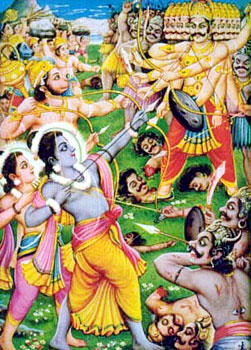
 The rakshasas play a very prominent part on the Ramayana, the beautiful epic of Valmiki. In the Ramayana, the Rakshasas are led by Ravana, the king of Lanka. Ravana is the rakshasa with ten heads and the mortal enemy of Rama, the hero of the Ramayana. Ravana kidnapped Rama`s wife Sita and carried her off to his kingdom, Lanka. Later Lord Rama was helped by the monkey King Sugriva and his army of monkeys to combat against Ravana. Rama killed Ravana, and rescued Sita.
The other celebrated Rakshasas are Ravana`s brothers Kumbhakarna and Vibhishana.
Kumbhakarna is the brother of Ravana. A fearsome warrior and master of illusion, he slept through most of the Battle of Lanka. At last he woke up and took the battlefield when Ravana awakened him with alarming news about the development of the conflict. When Kumbhakarna marched into the field, Rama`s monkeys immediately swarmed upon him. This caused him to laugh and to cause great chaos among them. When the monkey king Sugriva attacked, Kumbhakarna grabbed him and started to drag him off. It was at that point that Rama and his brother Lakshmana used arrows and a secret Brahmastra or a Brahma weapon to kill Kumbhakarna. Kumbhakarna fell down like a huge tree cleft in twain by a thunderbolt.
Vibhishana, Ravana`s younger brother, was a good-hearted rakshasa. He was handsome, pious and diligent in his religious observances. Lord Brahma blessed with the path of righteousness and illuminated by divine knowledge. Vibhishana joined Rama in his fight against Ravana, and helped Rama`s army to cross the ocean into Lanka. When imperceptible Rakshasas penetrated Rama`s camp, Vibhishana with his divine powers, made them visible. Later Rama`s monkey army destroyed them. After Rama`s final victory over Ravana, the loyal Vibhishana was made king of Lanka.
The Rakshasas have a great many appellations. They are called Asuras, Hanushas or `killers or hurters`; Ishtipachas, `stealers of offerings` and Sandhyabalas, `strong in twilight`. They are named as Kshapatas, Naktancharas, Ratricharas, and Samanishadas, the `night-walkers`; Nrijagdas or Nrichakshas, `cannibals`; Kilalapas, and Raktapas, `blood-drinkers` and many more.
Rakshasas
Rakshasas are the giants and the descendants of Pulastya, through Rakshas.