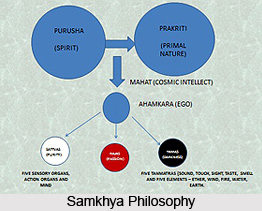
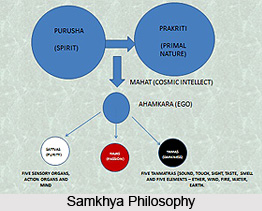
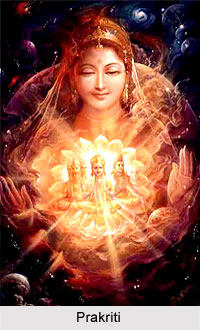
 Prakriti is the basic matter of which the Universe consists, as quoted by Vedanta Philosophy. Prakriti is composed of the three gunas or modes. The gunas are tamas or ignorance, rajas or passion and sattva or goodness. Prakriti is the female principle. It can also be used to denote the `feminine` in sense of the `male` being the Purusha. Vishnu as Purusha, combines with Prakriti, and engenders creation. Devi Prakriti Shakti in the perspective of Shaktis as forces unifies Kundalini, Kriya, Itcha, Para, Jnana, Mantrika Shaktis. Each is in a Chakra.
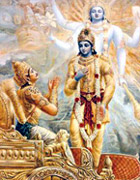
Prakriti is described in Bhagavata Gita as an inferior type of energy to the living beings or jivas, and to the Supreme Person, Paramatma or Bhagavan. It is closely related with the concept of Maya within Vedic scripture. As mentioned in the Ayurveda, the body is made up of three doshas. The three doshas are kapha, pitta and vayu. The balance or imbalance of these doshas defines the Prakriti of the body. Mulaprakriti is considered as the root of Prakriti and it is often described as the essence of matter. Mulaprakriti includes all classical elements.
The theory which traces creation to Prakriti has always been held as orthodox. Prakriti is a self-evolving principle, to which creation is to be traced. Prakriti is unending, invisible, indiscrete, brainless, and dynamic, except in a state of equipoise. In its Trinitarian essence Prakriti is the great omnificent principle as it gives energy. Prakriti energizes to liberate the soul from the bondage of misconception. It is the root of the perceptible universe. Prakriti is the unmanifested that is developing itself into the manifested. It is objective, illogical and productive. Prakriti is one indivisible substance that appears in endless varieties of forms. Prakriti is in reality bound and liberated unlike the soul.
Prakriti is considered to be humble as all the trouble that she takes in evolving creation out of its substance is for the benefit of the soul. Prakriti evolves only to be seen. Emancipation of Prakriti cannot be permanent as it energizes after long periods of serenity. Prakriti is a principle of great tenacity. It is more spiritual, a sort of ancient, self-evolving form.