|
 Mime is acting with no words. The roots of mime go back to prehistory, before mankind developed spoken languages. Presumably, when they were used gestures to communicate his thoughts. In India, the classical concept of abhinaya or acting constitutes four aspects, of which the angika or physical pertains to mime. It stresses the systematic coordination of facial and body muscles. Thus, in most traditional Indian theatre and dance forms like Kathakali. In that dance form every hand signal, movement, or facial expression has specific meaning. Their language of mudras resulted from ordinary gestures refined and codified into a sophisticated semiotics. However, they do not qualify as pure mime because they normally feature verbal narratives or supporting singers. They also employ elaborate and significant costumes and makeup. European mime is simpler, derived exclusively from human gestures, which are then honed and stylized, but not according to a predetermined grammar. Mime is acting with no words. The roots of mime go back to prehistory, before mankind developed spoken languages. Presumably, when they were used gestures to communicate his thoughts. In India, the classical concept of abhinaya or acting constitutes four aspects, of which the angika or physical pertains to mime. It stresses the systematic coordination of facial and body muscles. Thus, in most traditional Indian theatre and dance forms like Kathakali. In that dance form every hand signal, movement, or facial expression has specific meaning. Their language of mudras resulted from ordinary gestures refined and codified into a sophisticated semiotics. However, they do not qualify as pure mime because they normally feature verbal narratives or supporting singers. They also employ elaborate and significant costumes and makeup. European mime is simpler, derived exclusively from human gestures, which are then honed and stylized, but not according to a predetermined grammar.
Mime and pantomime are often confused. Both are originally classical Greek and Roman forms that utilized language. Popular modern mimic entertainment invented in eighteenth-century France. This art form completely omitted words, as did the spectacular nineteenth-century pantomimes of Jean-Gaspard Deburau. Mime now refers to the style formulated in France by Etienne Decroux in the twentieth century, and spread worldwide by his most famous pupil Marcel Marceau. He inspired 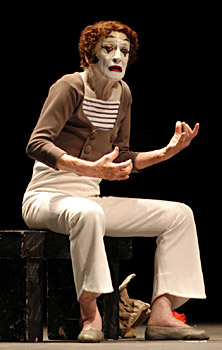 many Indians on his tour in 1960. In English-speaking countries, however, pantomime defines a particular genre of musical performances for children during the Christmas season. In a mime show, the actor wears a basic costume. This should be conventionally black and without any changes. No props or sets are required, though recorded music is a common ancillary. The performer suggests different objects and spaces, even if staying in one spot, through his gift of creating illusions so believable that he can virtually make the audience to see the prop or place. Therefore, he must cultivate his powers of observation and imagination in order to enlighten viewers. Frequently solo, a mime traditionally acts many roles in the course of a presentation, but group mime is equally effective. Marceau popularized the stock mime make-up, of a white mask with darkened eyes and lips, but not all artistes apply it now. many Indians on his tour in 1960. In English-speaking countries, however, pantomime defines a particular genre of musical performances for children during the Christmas season. In a mime show, the actor wears a basic costume. This should be conventionally black and without any changes. No props or sets are required, though recorded music is a common ancillary. The performer suggests different objects and spaces, even if staying in one spot, through his gift of creating illusions so believable that he can virtually make the audience to see the prop or place. Therefore, he must cultivate his powers of observation and imagination in order to enlighten viewers. Frequently solo, a mime traditionally acts many roles in the course of a presentation, but group mime is equally effective. Marceau popularized the stock mime make-up, of a white mask with darkened eyes and lips, but not all artistes apply it now.
As early as 1924, Rabindranath Tagore experimented with a mime production of his play Arup ratan i.e. 'Formless Jewel', but it contained songs by a seated chorus and recitation of the text by readers. The most renowned Indian mime, Jogesh Dutta, started performing in the 1960s influenced by Marceau, and established the Jogesh Mime Academy in Calcutta. Other disciples of the Marceau school included Irshad Panjatan, a soloist with a large repertoire of items. Among them Bunty Paintal acted in Hindi movies. Awanti Chawla acted in Vadodara and Janardan in Hyderabad. In Delhi, Alok Roy and Irfan Asgari used mime as a tool of social propaganda, the latter for the government's Song and Drama Division.
|





