Geology Of Godavari River
|
The geology of Godavari River suggests soil with rich alluvium deposits.
|
|
|
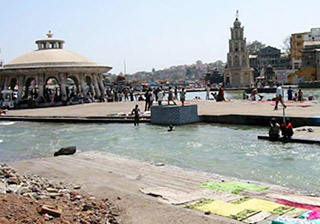 River Godavari is under the serious threat as a result of the growing civilization and industrialization. The river has been drying at a disturbing rate due to the pollution fashioned by the factories. The main reason behind the pollution of Godavari River is the small Nakavaggu rivulet that joins the Manjira, a tributary of the Godavari. Nakavaggu rivulet is not a source of life in its course. The rivulet is bounded by the extremely productive agricultural land, which is polluted by a huge number of industries located near the twin cities of Secunderabad and Hyderabad. However the 72 industries in the Patancheru Industrial area dumps the chemicals and waste into the water and thus changes the geology of the soil vastly. Some of the major diseases such as lung cancer, leukemia, and liver cancer in the region are due to this water pollution. The government of India has been constantly taking steps to save the river water from further pollution. River Godavari is under the serious threat as a result of the growing civilization and industrialization. The river has been drying at a disturbing rate due to the pollution fashioned by the factories. The main reason behind the pollution of Godavari River is the small Nakavaggu rivulet that joins the Manjira, a tributary of the Godavari. Nakavaggu rivulet is not a source of life in its course. The rivulet is bounded by the extremely productive agricultural land, which is polluted by a huge number of industries located near the twin cities of Secunderabad and Hyderabad. However the 72 industries in the Patancheru Industrial area dumps the chemicals and waste into the water and thus changes the geology of the soil vastly. Some of the major diseases such as lung cancer, leukemia, and liver cancer in the region are due to this water pollution. The government of India has been constantly taking steps to save the river water from further pollution.
The Godavari River, the third largest river in India and has been sampled for particulate inorganic and organic carbon (PIC, POC), particulate nitrogen (PN), and particulate amino acids (PAA, including 2 hexosamines (HA)). During the dry season, the river is abundance of particulate organic matter (POM) in the upper reaches and is relatively fresh and autochthonous. However, in the lower reaches it is tarnished and inorganic suspended matter content is much higher here.
In the wet season heavy rains cause a basin-wide flushing of humus from entire catchment area. As a consequence, POM in the river is mainly corrupted and allochthonous. Yearly transport of the Godavari River rises to around 2.81× 10sup6/sup ton POC, 0.29× 10sup6/sup ton PN and 0.10× 10sup6/sup ton particulate amino acid nitrogen. These amounts categorize the Godavari River to one of the most significant organic carbon transporting rivers in the world.
|
|
|
|
Articles you would like to read with Geology Of Godavari River
|
|
|
|
| • | Origin of Godavari River
The origin of Godavari River is at the Trimbakeshwar Temple in the district of Nasik in the Indian state of Maharashtra. It is a tirtha sthaan known as Kushavartham. The Brahmagiri hill is from where this holy river originated
| | |
|
|
|





