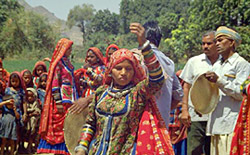
The Dom is an ethnic or social group who are scattered across India. They are segregated from the mainstream community as outcastes. At times they are called "Chandala". It is also believed that the Dom of the Middle East are descendants of Domba who were taken to Sassanid Persia as servants and musicians.
Its presumed root, dom, which is connected with drumming, is linked to damara and damaru. Dom in Himachal Pradesh exhibits the archetypical characteristics of an indigenous hunter gatherer tribe who has been incorporated as part of the caste system. They are generally agricultural workers, basket weavers and small scale agriculturalist. In Andhra Pradesh they are known as Dommara and are a Telugu speaking caste of people found in the Nalgonda district in Andhra Pradesh. In the temple town of Yadagirigutta they are used for the flesh trade by others. With regard to the Dom community in Orissa they speak indo-Aryan Oriya language. In Varanasi they perform the most important task of cremation of dead bodies. In ancient literature they are considered as a scheduled or Dalit caste in Bengal, Bihar and Kashmir. In Tamil Nadu they are known as Dombar or Thombar and are found in villages around the city of Salem. They are mainly Tamil speakers. They are also found considerably in Karnataka.
Doms have long been workers at cremation places, scavengers, or weavers of ropes and baskets. They are traditionally well known for their musical ability. Even till today, the various Dom communities continue to provide India with skilled musicians. Most currently some Dom earns their living by entertaining as street performers and jugglers. The Doms also manufacture various articles from the bark of the bamboo. Doms are also employed as street-sweepers and they assist at the cremation of the dead, laying the logs of wood in order on the ground, and bringing the lighted straw.
They are considered inferior even to the members of the scheduled castes though they do not belong to any tribe or aboriginal group. Their miserable social status can be attributed to their economic instability. The Bengali Dom are divided into two sections-Baja-nia or musician and Ankuria or basket-makers.