


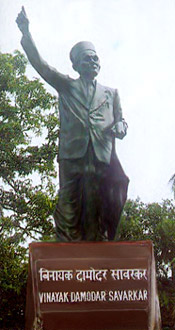
 Veer Savarkar was a revolutionary freedom fighter.He played an instrumental role in the development of Hindu nationalist political ideology Hindutva.
He was also a poet, writer and playwright. The five philosophical dimensions of Savarkar were Utilitarianism, Rationalism and Positivism, Humanism and Universalism, Pragmatism and RealismVinayak Damodar Savarkar, lovingly known as 'Veer Savarkar', matriculated in 1901. He received further education in Fergusson College, Pune and graduated from Bombay University. As early as 1899, V.D. Savarkar and his brother Ganesh Savarkar established a revolutionary society 'Mitra Mela' for teaching of drill and physical exercises to its members. Savarkar was greatly influenced by Mahatama Sri Agamay Guru Paramhansa who was preaching revolution by force. On 9th June 1906, Savarkar left for London where he reached in July 1906. In January 1910 he had gone to Paris and returned to London on 13th March 1910 when he was arrested on the Victoria Railway Station in pursuance of the arrest warrants issued by the Bow Street Court London on 22nd February 1910 for the offence of "waging war against the King Emperor". The court orders for Savarkar's return to India were issued on 12th May 1910 and he was finally put in the ship S.S. Morea on 1st July 1910 for journey to India. Each day, rather each minute spent by V.D. Savarkar in London was devoted by him for revolutionising the minds of Indian youth, as has justly been described by Harindra Srivastava in his appreciable book Five Stormy Years, Savarkar in London (1983). Veer Savarkar was a revolutionary freedom fighter.He played an instrumental role in the development of Hindu nationalist political ideology Hindutva.
He was also a poet, writer and playwright. The five philosophical dimensions of Savarkar were Utilitarianism, Rationalism and Positivism, Humanism and Universalism, Pragmatism and RealismVinayak Damodar Savarkar, lovingly known as 'Veer Savarkar', matriculated in 1901. He received further education in Fergusson College, Pune and graduated from Bombay University. As early as 1899, V.D. Savarkar and his brother Ganesh Savarkar established a revolutionary society 'Mitra Mela' for teaching of drill and physical exercises to its members. Savarkar was greatly influenced by Mahatama Sri Agamay Guru Paramhansa who was preaching revolution by force. On 9th June 1906, Savarkar left for London where he reached in July 1906. In January 1910 he had gone to Paris and returned to London on 13th March 1910 when he was arrested on the Victoria Railway Station in pursuance of the arrest warrants issued by the Bow Street Court London on 22nd February 1910 for the offence of "waging war against the King Emperor". The court orders for Savarkar's return to India were issued on 12th May 1910 and he was finally put in the ship S.S. Morea on 1st July 1910 for journey to India. Each day, rather each minute spent by V.D. Savarkar in London was devoted by him for revolutionising the minds of Indian youth, as has justly been described by Harindra Srivastava in his appreciable book Five Stormy Years, Savarkar in London (1983).
In 1907, Savarkar celebrated the golden jubilee of the Indian War of Independence (1857) with the aim to honour the martyrs. Savarkar gathered a multitude of Indian youth and injected in them the intensity to fight for freedom. He also commemorated the Indian national uprising of 1857 in India House in London on 10th May 1908 and released a two-leaf pamphlet titled, "O' Martyrs!" which was considered as "a blast in London that set the Thames on fire"." The birth anniversary of Guru Gobind Singh, the tenth Sikh guru, a great poet and a great warrior was also celebrated on 29th December 1908 in Caxton Hall, Westminster. Savarkar himself invited all Indians to attend the celebrations. Gifted with the ability to make a moving speech, immaculate sincerity and blazing heart, Savarkar thrilled his audience. 'Vande Mataram' (Hail Motherland) was popularised by him as a national hymn. After one year of exhausting research in the India Office Library, Savarkar wrote The Indian War of Independence of 1857. The book was proscribed even before publication. It was originally written in 1908 in Marathi. The manuscript was smuggled into India by the revolutionaries. The British authorities failed to lay its hands on it even in India and the manuscript reached Paris. It was translated into English under the supervision of V.V.S. Aiyar and the English manuscript was also sent to Paris. It was printed in Holland and the books were smuggled into India under fake fine-looking title covers. This book not only corrected the British version of the national uprising of 1857, but also became a bible for the revolutionaries. While in Europe, V.D. Sarvarkar maintained his relations with a revolutionary society known as 'Abhinav Bharat Samaj' in Maharashtra. Twenty Browning automatic pistols with ammunition were sent by him through one Chaturbhuj Amin, a cook in India House in London who reached Bombay on 6th March 1909, about a week after the arrest of Ganesh Savarkar. One of these pistols was used on 21st December 1909 by A.L. Kanhare for shooting down Jackson, district magistrate of Nasik. During the investigation a conspiracy was came to light. Savarkar's residence was searched and some incriminatory books and documents were seized. It led to the framing of the Nasik Conspiracy Case. An arrest warrant for V.D. Savarkar was also issued in this case. He was arrested on 13th March 1910 and lodged in Brixton prison. He was put on board the liner Morea on 1st July 1910. The vessel touched at Marseilles on 6th July 1910. Savarkar went to the water closet of the ship on 8th July. Stripping himself practically of all his clothes, he escaped through the port-hole into the sea, swam ashore and ran three meters into the French territory. The English guards ran after him, shouting, "Thief, Thief". Then two French marine gendarmes (French for policeman) ran after him and caught hold of him. They handed him over to the British guards. Savarkar could not speak French and so could not reveal his identity as a political refugee. His recapture created a sort of celebrated question in international law. Savarkar was brought to Bombay on 22nd July 1910. A special tribunal was set up for his trial under the Special Tribunal Act which had no jury and which had no provision for appeal. It consisted of the chief justice of Bombay high court, Sir Basil Scoth, Sir N.G. Chandravarkar and justice Heaton. VD. Savarkar was defended by Govindrao Gadgil and Rangneker. The case involved thirty-eight persons including VD. Savarkar. The trial opened on 15th September 1910. Since V.D. Savarkar had challenged his extradition to British India in the international forum, he declined to surrender to the jurisdiction of Indian courts and refused to make any statement or bring any evidence in defence. The tribunal, however, proceeded with the trial regardless of his plea and without waiting for the verdict of the international forum. The trial lasted for sixty-eight days. The judgement was announced on 23rd December 1910. Apart from Keshab Chandra, twenty-eight others were also convicted and eight were acquitted. Savarkar was convicted and sentenced to transportation for life and his property was confiscated. In the second Nasik Conspiracy Case, Savarkar was charged with abetment in the murder of Jackson, collector of Nasik. He was convicted and sentenced to another deportation for life on 30th January 1911. The Hague Tribunal announced the judgement in the extradition case on 24th February 1911. He was sent to the Andamans in July 1911. The first poem Savarkar composed was on Guru Gobind Singh, the sire of martyrdom. He was repatriated in 1921. After the assassination of Mahatma Gandhi on 30th January 1948, Savarkar was also arrested on 5th February 1948 as one of the alleged conspirators. He was then sixty-five years old. The judgement was announced on 10th February 1949, in which he was acquitted. VD. Savarkar till then was detained in the Red Fort. The hero of the freedom movement passes away in 1966. |
| |||



Vinayak Damodar Savarkar
| Vinayak Damodar Savarkar was justly renamed `Veer`, for his intimidating and intrepid spirit for freedom. |
| ||||||||||||||||||||||||||||

