Religious significance of Narmada
|
The Narmada is one of the most sacred of the five holy rivers of India.
|
|
|
 The religious significance of Narmada River lies in its origin. The river is one of the most sacred of the five holy rivers of India; the other four sacred rivers of India are Ganga, Yamuna, Godavari and Kaveri. It is believed that a dip in any of these five rivers washes ones sins away. Ptolemy has mentioned the river in the 2nd century AD as Namade. The Ramayana, the Mahabharata and Puranas refer to it often. The Rewa Khand of Vayu Puran and the Rewa Khand of Skand Puran are completely devoted to the story of the birth and the significance of the River and hence Narmada is also called Rewa. The religious significance of Narmada River lies in its origin. The river is one of the most sacred of the five holy rivers of India; the other four sacred rivers of India are Ganga, Yamuna, Godavari and Kaveri. It is believed that a dip in any of these five rivers washes ones sins away. Ptolemy has mentioned the river in the 2nd century AD as Namade. The Ramayana, the Mahabharata and Puranas refer to it often. The Rewa Khand of Vayu Puran and the Rewa Khand of Skand Puran are completely devoted to the story of the birth and the significance of the River and hence Narmada is also called Rewa.
There are many fables about the source of the Narmada. According to a myth, once, Lord Shiva, meditated so hard that he started perspiring. Shiva's sweat gathered in a tank and started flowing in the form of a river - the Narmada. Another legend has it that two teardrops that fell from the eyes of Lord Brahma, the Creator of the Universe, yielded two rivers - the Narmada and the Son.
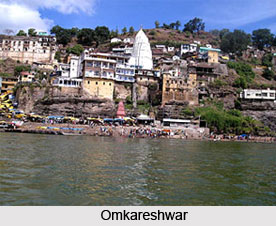
Legends also say that for Lord Shiva, the Hindu God, the river is particularly sacred on account of its origin, and it is often called Shankari or the daughter of Shankar. All the pebbles rolling on its bed are said to take the shape of his emblem with the saying - Narmada Ke Kanker utte Sankar that is a popular saying in the Hindi belt of India. This saying means that 'pebble stones of Narmada gets a personified form of Shiva'. These lingam shaped stones are called Banalinga or Banashivalingas. These pebbles are much sought after for daily worship by the Hindus. The Brihadeeswara Temple in Thanjavur, Tamil Nadu is constructed by Rajaraja Chola and possesses one of the biggest Banalingas. Adi Shankara met his guru Govinda Bhagavatpada on the banks of river Narmada. Important places of pilgrimage along this river are Amarkantak, Omkareshwar, Maheshwar, Mahadeo temples, Nemawar Siddeshwar Mandir, Chausath Yogini, Chaubis Avatar Temple and others.
This article is a stub. You can enrich by adding more information to it. Send your Write Up to content@indianetzone.com
|
|
|
|





