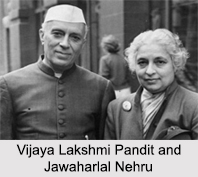
Vijaya Lakshmi Pandit, Indian Freedom Fighter - Informative & researched article on Vijaya Lakshmi Pandit, Indian Freedom Fighter
 Indianetzone: Largest Free Encyclopedia of India with thousand of articlesIndian Personalities


in  
 Art & Culture|Entertainment|Health|Reference|Sports|Society|Travel
Forum  | Free E-magazine  | RSS Feeds  
Indian Personalities : Indian Prime Ministers |Indian Politicians |Indian Businessmen |Indian Scientists |Indian Freedom Fighters |Indian Businesswomen |List of Indian Speakers |Governors of Indian States |Indian Spritural Gurus |Indian Social Reformers |Indian NRIs |Indian Fashion Designers |Indian Sportspersons |Indian Magicians |Indian Social Activists |Indian Women Activists |Personalities of Indian States |Indian Mathematicians |Indian Beauty Pageant Winners |Indian Physicians |Indian Historians |Chief Ministers of Indian States |Indian Economists
Home > Society > Indian Personalities > Indian Freedom Fighters > Vijaya Lakshmi Pandit
Vijaya Lakshmi Pandit, Indian Freedom Fighter
An Indian diplomat and politician, she was the first female President of United Nations General Assembly.

 Vijaya Lakshmi Pandit (1900 - 1990)Vijaya Lakshmi Pandit was the first female President of United Nations General Assembly. She was an Indian diplomat and politician. Moreover to her credit, she was the sister of Jawaharlal Nehru, the first Prime Minister of India. She was India`s first woman Cabinet Minister and the first woman to lead a delegation to U.N. She was the world`s first woman ambassador who served three prized ambassadorial posts at Moscow, Washington and London. She considered Indian National Congress as her own family as she was born into it. According to her, politics is a means of social and economic reform, which strengthens human rights and empowers women. She was against monopoly of power by one family.

Vijaya Lakshmi Pandit was born on 18 August 1900 at Allahabad. She was the daughter of Motilal Nehru and Swarup Rani Nehru. Her father had great admiration for the west and took the best he knew from it. According to him, "Western" meant discipline, rationality, a sense of adventure and a practical approach to problems. He was a rebel who was against caste barriers and outdated customs. He was not at all worried to throw away anything that he did not consider wise. He did not fear criticisms. He even sent his son, Jawaharlal Nehru to Cambridge to study. Her mother`s life revolved around her family and her religious observances. She did not speak English but she fulfilled her duties and accompanied her husband to English homes. Her own home was the centre of the contrasts present in the country. In her home, tradition and modernity co-existed harmoniously.

In her autobiography, The Scope of Happiness, Vijayalakshmi describes her childhood as a period of contradictions and contrasts and as a period of transition from age-old traditions and prejudices to new ways of living and thinking. Motilal`s powerful molding influence was greatest on Vijayalakshmi Pandit, who, of his three children, resembled him in her temperament, her zest for life and her involvement with other human beings. At a very early age Vijayalakshmi was very much interested in politics. At sixteen she attended her first political meeting, organized by her cousin Rameshwari Nehru at Manyo Hall of Allahabad University to assemble women in a protest against the treatment of Indian labourers in South Africa. At sixteen, she wished to join Annie Besant`s Home Rule League but being too young, she was allowed to enroll only as a volunteer. She was married to Ranjit Pandit, who was a cultured litterateur, aristocrat, and barrister from Kathiawar. They married on May 10, 1921, when she was about 21 years old. Three children were born to her- Chandra Lekha, Nayantara and Rita Vitasta

In her mid thirties she was elected to the Allahabad Municipal Board. She was arrested and sentenced to eighteen months imprisonment for presiding over a crowded public meeting where the Independence pledge was taken. This was the first of her three imprisonments. When the Indian National Congress took part in provincial elections she and her husband, Ranjit S. Pandit, were elected to the U.P. Assembly. Vijayalakshmi was appointed as the Minister for Health and Local Self-Government.

For two continuous years she was the President of the All-India Women`s Conference. Tragedy struck her with the death of her husband after his last imprisonment in 1944. As he had left no will, she was left virtually penniless, as Hindu widows had no inheritance rights. His brother claimed all his investments and earning and made everything in his custody. Shaken by her grief and without knowledge of future and with no source of support from her brother, as he was imprisoned she left for Bengal to work, where cholera had spread in the wake of famine, and to set up a Save the Children Fund. During this time, Gandhiji was released from jail and he asked her to go to America to speak about actual conditions in India. This became possible when Sir Tej Bahadur Sapru(President of the Indian Council for World Affairs) included her in an Indian delegation to the Pacific Relations Conference to be held in Virginia.

She became the member of the Constituent Assembly that drafted the Constitution. After Independence she was twice elected to Parliament and she led India`s first Goodwill Mission to China and served as Governor of Maharashtra. She resigned her post to stand for election to Parliament from the constituency of Phulpur that was vacated as a result of Jawaharlal Nehru`s death. Four years later, she resigned from the Lok Sabha as it was difficult for her to serve her party under Indira Gandhi. During the Emergency, she stepped out of retirement to speak out against dictatorship and dynasty. She could not find a place in the power structure under Indira Gandhi.

She collected more than eight honorary degrees from the world universities besides those offered to her in India. She celebrated her ninetieth birthday by inviting her family members, (who were at the time both in government and in the opposition) to lunch in Dehra Dun. All members came regardless of political difference. It was a grand function and it happened to be her farewell as she died two months later. It was Rajiv Gandhi, who personally supervised her last rites. Vijayalakshmi used to say that none should mourn her death as she had lived long. Her family members took her word to heart and at Sangam instead of mourning her death they celebrated her life. Her life was actually an example, which all humanity could follow. She had great will power; she was courageous in her agonizing situations and led her life triumphantly. Till the end she was fully involved in her life. This great personality breathed her last on 1 December 1990 at Dehra Dun.

(Last Updated on : 15/01/2009)
 
 
Bal Gangadhar Tilak Jatindranath Mukherjee Jayaprakash Narayan
Barindra Kumar Ghose Madan Mohan Malviya Khudiram Bose
Sucheta Kriplani Lala Lajpat Rai Gopal Krishna Gokhale
Dr B R Ambedkar Ramabai Ranade Sister Nivedita
Nellie Sengupta Sarala Devi Chaudhurani Sir Sayyid Ahmad Khan
Madam Bhikaji Cama Shoilabala Das Maulana Hasrat Mohani
Sarojini Naidu Dr. Welthy H. Fisher Kamala Nehru
Nawab Mohammad Ismail Khan Kamraj Bhograju Pattabhi Sitaramayya
Kanaiyalal Maneklal Munshi Begum Kudsia Aizaz Rasul Pattom A. Thanu Pillai
Mahatma Gandhi Minocher Rustom Masani Subash Chandra Bose
Homi Modi Bhagat Singh Pratap Singh Kairon
Jai Rajguru Malati Choudhury Sardar Vallabhbhai Patel
Maulana Abul Kalam Azad Rafi Ahmed Kidwai Chakravarti Rajagopalachari
Anugrah Narayan Sinha Durgabai Desmukh Leela Roy Nag
Asaf Ali Jagjivan Ram Mahavir Tyagi
Ammu Swaminathan Biswanath Das Gopinath Bordoloi
Krishna Ballabh Sahay Purushottamdas Tandon Dr. Bhagwan Das
Jaipal Singh Munda P. Subbarayan Sir R. K. Shanmukham Chetty
Sri Krishna Sinha Pandit Raghunath Vinayak Dhulekar Acharya Kripalani
Basanti Devi Mira Behn Asha Devi Aryanayakam
Prabhawati Devi Sophia Khan Ashalata Sen
Jethinben Tulsidas Siphilmalani Maniben Kara Leela Roy
Vijaya Lakshmi Pandit Kamaladevi Chattopadhyaya Aruna Asaf Ali
Hansa Mehta Sita Devi Renuka Ray
Muthulakshmi Reddy Durgabai Deshmukh Jayashri Raiji
Malati Nabakrushna Choudhary Maniben Nanavati Soundram Ramachandran
Chandra Shekhar Azad Harekrishna Mahatab Kazi Syed Karimuddin
Khurshidben Naoraji Perinben Naoraji Satyavati Devi
Maniben Patel Ishwar Chandra Vidyasagar Mangal Pandey
Sarat Chandra Bose Dadabhai Naoroji Ladha Ram
Vinayak Damodar Savarkar Pandit Rambhuj Dutt Choudhary Surya Sen
Benoy Krishna Basu Badal Gupta Dinesh Chandra Gupta
Chittaranjan Das Surendra Nath Banerjee Prafulla Chaki
Rash Behari Bose Motilal Nehru Samaldas Gandhi
Giani Pritam Singh Dhillon Bhulabhai Desai Tarun Ram Phukan
Krishna Nath Sarmah Sundara Sastri Satyamurti Mukund Ramrao Jayakar
V. S. Srinivasa Sastri Tanguturi Prakasam S. Srinivasa Iyengar
Ashwini Kumar Dutta Shyam Sundar Chakravarthy Krishna Kumar Mitra
Rammanohar Lohia Basawon Singh Acharya Narendra Deva
Asoka Mehta Yadunandan Sharma Yamuna Karjee
Karyanand Sharma Tridib Chaudhuri Govind Ballabh Pant
Narayandas Malkani Suhasini Das Agha Shorish Kashmiri
Jogendra Nath Mandal Kunwar Singh Sheel Bhadra Yajee
Maulana Mazharul Haque    
Recently Updated Articles in Indian Personalities
Manav Gangwani
Manav Gangwani is the Indian Fashion Designer for whom fashion is all about sensuality and an adept expression of individuality.
Rajesh Pratap Singh
Rajesh Paratp Singh is the Indian Designer whose works continue to exude creative supremacy on the runway.
Falguni and Shane Peacock
Falguni and Shane Peacock are the designer duos who have contributed a lot to the domain of fashion.
Aparna Jagdhari
Aparna Jagdhari is the fashion designer whose work reflects the perfect mixture of diverse techniques and modern methods.
Deepika Govind
Deepika Govind is the fashion designer who style states simplicity and clothes depict the contemporary classicism.
E-mail this Article | Post a Comment
Forum
Forum on Indian Personalities
Free E-magazine
Subscribe to Free E-Magazine on Society
 
 
Vijaya Lakshmi Pandit, Indian Freedom Fighter - Informative & researched article on Vijaya Lakshmi Pandit, Indian Freedom Fighter
Sitemap
Contact Us   |   RSS Feeds
Copyright © 2008 Jupiter Infomedia Ltd. All rights reserved including the right to reproduce the contents in whole or in part in any form or medium without the express written permission of
Jupiter Infomedia Ltd.