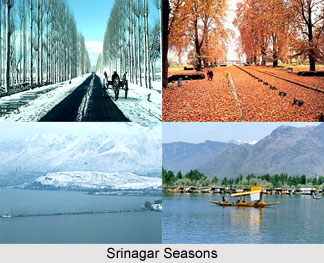
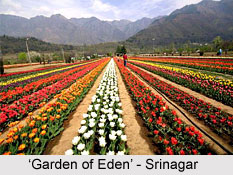
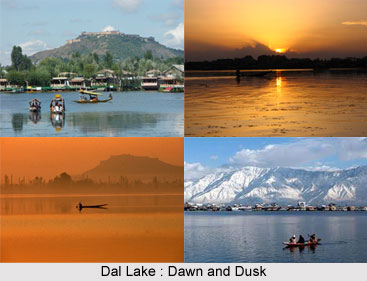
 Srinagar is truly "heaven on earth" with each of the four seasons heralding new delights, the almond blossom of spring, the lotus flowers of summer, and the saffron fields of autumn and snow cover trees of winter. Srinagar is the summer capital of the state Jammu & Kashmir in India, and is situated in the valley of Kashmir. The city lies on both banks of the Jhelum River, a tributary of the Indus River. It`s famous for its lakes and also houseboats that float over them. Also it is known worldwide for traditional Kashmiri handicrafts and dry fruits.
History of Srinagar
According to the history of words, the word Srinagar is composed of two Sanskrit words, namely, `Sri` meaning abundance and wealth and `Nagar` that means city. `Sri` is also the name of a goddess of Hindus. A legend as incorporated in Nila`s Nilmatapurana states that the Kashmir valley initially was a vast lake. A Hindu sage named Kshyapa drained out this water and there emerged the beautiful valley of Kashmir. It is said emperor Ashoka when laid the foundation of his capital of the region, named it `Srinagari`. Later many emperors came and changed the name according to their preferences but later original name `Srinagar` was retained. The Hindu and Buddhist rulers lasted till 14th century after which Kashmir valley and city came under the control of several Muslim leaders including Mughals. Akbar established Mughal rule in the valley and city. When the disintegration of the Mughal Empire set forth in 1707, infiltrations to the valley from the Pathan tribes increased and they ruled over for several decades. Raja Ranjit Singh in 1814 annexed a major part of Kashmir valley, including Srinagar to his kingdom and the city came under the influence of Sikhs. Subsequent to the treaty between the Sikh rulers and the British in Lahore in 1846(treaty of Lahore), inter alias provided British suzerainty over the Kashmir valley. British kept Gulab Singh as an independent and sovereign ruler, and Srinagar became part of his kingdom, and remained princely state of undivided India for years together.
 Geography of Srinagar
Srinagar lies between two hills, the Hari Parbat and the Shankar Acharya (also known as Takht-i-Suleiman). The city had experienced several natural disasters. Before the nineteenth century, Srinagar had been destroyed and rebuilt six times. Two major fires, in 1892 and 1899, devastated large portions of the city. There have been eleven major earthquakes in the city since the fifteenth century.
It is located on both sides of river Jhelum, which is also called vyath in Kashmiri. The river passes through the city and meandering through the valley,moves onwards and deepens in Wular Lake. The city is famous for its nine old bridges,connecting two parts of the city. Hokersar,the capital of Indian Kashmir ,14 kilometers from srinagar,is a world class wetland including lake and marshy area.It is the most well known and accessible of all the wetlands of kashmir.
Economy of Srinagar
Srinagar is the main centre of the economy of the Kashmir Valley, and has remained tourist destination for centuries. The city remained on the itinerary of the Mughal ruling elite, and several Mughal emperors and their consorts had visited the city, and several Mughal gardens in and around the city indicate their close association with Srinagar. After the colonization of India by Europeans, the ruling elite as well as rich Indians used to visit the city and nearby locations during summers to avoid heat of the plains and during winters to enjoy the snowfall. Another significant segment of the economy include handicrafts, weaving of woolen shawls and dress material and woodcarving. Srinagar serves as one of the collecting point from where fruits and handicraft products are taken to several parts of Indian subcontinent. Srinagar also has specialized markets and retail shops. The hinterland of Srinagar is the most populous part of the Kashmir valley, and crops like wheat and paddy are cultivated for local consumption. Orchards produce a number of fruits, particularly apples.
 Cuisine of Srinagar
Rich and redolent with the flavour of the spices used -cinnamon, cardamom, clove, saffron, etc. Kashmiri food can be the simple meal of a family, or a 36-course wedding banquet called Wazawan. The staple diet of every Kashmiri is rice; the most preferred being the dense, slightly sticky grained Kashmir variety, which is prized in the Valley. Mutton, chicken or fish are of prime importance in Kashmiri meal and everyday cooking often combines vegetable and meat in the same dish.
Mutton and turnips, chicken and spinach, fish and lotus root are also very popular combinations. Pure vegetarian dishes include dum-aloo - roasted potatoes in curd-based gravy, and chaman- fried paneer (cottage cheese), in a thick sauce. Non-vegetarian dishes are considered in Kashmir to be a sign of lavish hospitality and at a Wazwan or banquet, not more than one or two vegetarian dishes are served. Sweets do not play an important role in Kashmiri cuisine. Instead Kahva or green tea is used to wash down a meal.
Culture of Srinagar
Srinagar has a distinctive blend of cultural heritage. Holy places in and around the city depict the historical cultural and religious diversity of the city as well as Kashmir valley.
Bhand Pather is a form of traditional folk theatre art form of play and dance. The artists depict in a satirical style social evils. Chakri is a form of Kashmiri folk music and is the most popular. Another very well known form of Kashmiri music is Sufiana music. It was introduced in valley in 15th century from Iran. Over the years, it has assimilated a number of Indian Ragas, and has established itself as classical music of this particular region. The instruments used in the music include Santoor, Sitar, Kashmiri Saz, Tabla and Wasool. Hafiz Nagma is a form of Dance that is performed to the accompaniment of Sufiana music.