


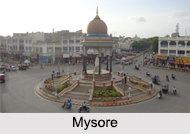
 Mysore, also spelt as Mysuru is a decorated place in Southern part of India (South Indian States). The existence of Mysore can be traced from mythological history of India and later in early history and medieval history. It is said from the folk lore, Mahishasura ruled the area which is presently known as Mysore in modern Mysuru District of Karnataka. Mysore, also spelt as Mysuru is a decorated place in Southern part of India (South Indian States). The existence of Mysore can be traced from mythological history of India and later in early history and medieval history. It is said from the folk lore, Mahishasura ruled the area which is presently known as Mysore in modern Mysuru District of Karnataka.
Location of Mysore Mysore is located at the southwest of Bengaluru. Mysore spreads an area of 128.42 square kms which extends at the foot hills of Chamundi hills. The latitudinal and longitudinal location of Mysore is around 12.30 degree North and 76.65 degree East which has an average altitude of 770 meters or 2526 ft. History of Mysore 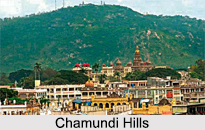 Mysore played a very significant role from the early era till the British Raj. This city continued to remain the capital of the Mysore Kingdom which was under the rule of Wodeyar dynasty. This city came under the rule of Haidar Ali and Tipu Sultan for a very short period of 40 years. According to the Hindu mythology Mysore was ruled by the famous demon Mahisha- Mahishasur who was killed by Goddess Chamunda. From that time, Mysore received its name from the legendary mythological ruler Mahishasura. The place was originally known as Mahisha or Mahishasuru. Mysuru or Mysore includes some of the popular historical monuments, forts, archaeological ruins and Mahishasuru fort which was built by Chamaraja Wodeyar III in medieval era. Mysore was the governmental centre till 1610 AD when the Wodeyars exiled the Vijayanagara governor in Shirangapatnam and shifted the capital to Shirangapatnam. Later Mysuru or Mysore came under the control of British Empire in India till India got Independence in 1947. Mysore played a very significant role from the early era till the British Raj. This city continued to remain the capital of the Mysore Kingdom which was under the rule of Wodeyar dynasty. This city came under the rule of Haidar Ali and Tipu Sultan for a very short period of 40 years. According to the Hindu mythology Mysore was ruled by the famous demon Mahisha- Mahishasur who was killed by Goddess Chamunda. From that time, Mysore received its name from the legendary mythological ruler Mahishasura. The place was originally known as Mahisha or Mahishasuru. Mysuru or Mysore includes some of the popular historical monuments, forts, archaeological ruins and Mahishasuru fort which was built by Chamaraja Wodeyar III in medieval era. Mysore was the governmental centre till 1610 AD when the Wodeyars exiled the Vijayanagara governor in Shirangapatnam and shifted the capital to Shirangapatnam. Later Mysuru or Mysore came under the control of British Empire in India till India got Independence in 1947.
Climate of Mysore Mysore enjoys a pleasant climate throughout the year. Summer season extends from March to June which is followed by the monsoon season in July to November. And winter season in December that continues till February. The highest degree of temperature recorded is 38.5 degree Celsius. Demography of Mysore 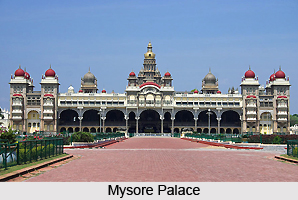 According to the Population Census in the year 2011, Mysore had a population of 887,446. Out of which 443,813 were males and 443,633 were females, thus making it the second most densely inhabited urban area in Karnataka. According to the Population Census in the year 2011, Mysore had a population of 887,446. Out of which 443,813 were males and 443,633 were females, thus making it the second most densely inhabited urban area in Karnataka.
Economy of Mysore Mysore or Mysuru derives a lot of earning from tourism which is one of the main industries in Mysore. Tourism contributes heavily to the state treasury. Along with it Mysore also has some cottage industries and small scale industries which manufacture the sandalwood products, matchboxes and incenses. Along with this there are some automobile manufacturing industries and information technology companies which add to the state's earnings. Culture of Mysore Mysuru city has been the cultural capital of Karnataka. The ethnicity, culture and traditional heritages of Mysore or Mysuru is portrayed with the advent of many South Indian festivals, religious fairs, religious festivals, palaces and paintings which represents the true spirit of Mysore from the early era. Dussera is celebrated in Mysore with pomp. Tourism in Mysore Mysore is surrounded with a number of tourist spots in and around which include some prominent places like Mysore Palace, Chamunda Hills, Zoo, St. Philomena's Church, Jaganmohan Palace, Ranganathittu, Somanathpur, Krishnrajasagar Dam and Brindavan Garden. |
| |||



Mysore
| Mysore which is also known as Mysuru is the second largest city of Karnataka, well known for the legends and festivals. This is one of the most decorative royal cities of South India located at a distance of 146 kms from Bangalore- the capital of Karnataka. |
| ||||||||||||||||||||||||||||

