


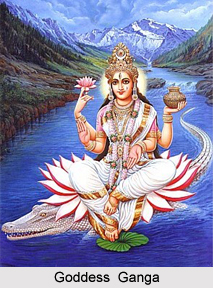
 The Ganga or the Ganges is considered to be holy among the Hindus. There are several stories attached with the importance of Holy Ganges. This multi-facet Goddess Ganga has a huge contribution in the epic Mahabharat. In fact to be precise, the existence of Bhishma- an important character of Mahabharat is justified by the Santanu-Ganga relationship. The Ganga or the Ganges is considered to be holy among the Hindus. There are several stories attached with the importance of Holy Ganges. This multi-facet Goddess Ganga has a huge contribution in the epic Mahabharat. In fact to be precise, the existence of Bhishma- an important character of Mahabharat is justified by the Santanu-Ganga relationship.
Santanu-Ganga relationship Shantanu, the king of Hastinapur had conquered all nearby Kingdoms and not only expanded the borders of his kingdom, but made them safe as well. He was tired and came home to relax. He would often go to the banks of the river Ganga and dream of a love life, when one day he saw a woman beautiful beyond explanations. He asked her name and she said Ganga. They met often and then one day the woman revealed that she was the personified image and actual human at that time, she was the personification of the sacred Ganga River. She further revealed that Shantanu himself was originally a Devata and that they were punished for a sin that they had committed. The sin was that in spite of being deva and devi, they both got attracted to each other. This was not allowed, as they had to curb these desires in order to progress towards the path of God. Thus they lost their stature of devta. For this offence, both of them were punished with a life on earth. Since Shantanu's sin was greater he was to live a full life and since Ganga's sin was lesser and hence her punishment was less intense. After knowing this Shantanu proposed and Ganga agreed to marriage, but there was a precondition. She cited that after marriage Santanu should not question her for her actions. Shantanu agreed. He, however, did not place much importance to the issue. However as Ganga gave birth to their children she begin to drown them in the water. Bewildered with her actions Santanu confronted her and asked her the reason for drowning their children, thus breaking his promise. By, breaking the word, Shantanu had freed Ganga from Brahma's curse and though she loved him, she would have to return to the higher world. However, by breaking the word before the child was put to water, Shantanu had created a situation whereby the child would now have to live a life.Ganga revealed that for those living in the higher world, coming to earth for life meant not only lowering their achievements, but to be exposed to pain again. She said that there were eighth "Vasu's" who had been cursed by Brahma for life on earth and later, as a pardon, they were told that either their life would be short or they would enjoy tremendous fame on earth. When Ganga decided to marry Shantanu, the curses of Ganga, Shantanu and the nine Vasus were matched and Ganga agreed to bear the vasus as their children. To spare them the pain, she killed them immediately after birth following which, they, were freed of the curse, and thus regained their divine places. However, as Shantanu asked Ganga about it all before the eighth Vasu could be drowned, he had forced this one to live, for now Ganga was no more in human form as she had regained her diviner form. Though Shantanu realized his mistake, he could do nothing, for Ganga was gone. However, Ganga granted him the concession of meeting her sometimes in person when Shantanu would come to the banks of the river. She also told Shantanu that she would take the child away for fifteen years and take him to the higher worlds where he would get all his education from the divine seers. Saying this, she and the child disappeared. Fifteen years passed slowly for him, for he would wait for Ganga for hours at the riverbank. She would come sometimes and not, sometimes. Then, one day, Ganga brought him a gift. Their son, Devavrata, was brought to earth, having finished his education from the divine teachers. Due to his hereditary greatness, his divinity and his great teachers, Devavrata was the master of everything: from finance, politics, arts, crafts, and science to athleticism and war techniques. Devavrata later came to be known as Bhishma. |
| |||



Goddess Ganga
| Multi-faceted Goddess Ganga and the river is considered to be holy among the Hindus who married Shantanu. |
| ||||||||||||||||||||||||||||

