With a combination of bulbs one can ensure the garden remains colorful with bulbs blooming all round the year. Though bulbs are easy to plant, certain care should be taken while growing them. It is also recommended that one should plant bulbs during the fall season. Some of the popular varieties of Bulbs are: Peacock Flower, Iris, Day Lily, Tulip, Windflower, Daffodils and Crocus.
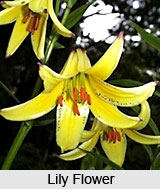 Lily: The botanic name Lilium is the Latin form and is a Linnaean name. The Latin name is derived from the Greek leirion, which is generally assumed to be the Madonna lily. The term "lily" (generally with a modifier, such as "water lily", "daylily", "arum lily" or "blackberry lily") is also applied to a large number of other plants, which have flowers that may resemble true lilies to a greater or lesser extent. Most of them are quite unrelated to the true lilies. The large flowers have three petals along with three petal-like sepals, often fragrant, and come in a range of colours ranging through whites, yellows, oranges, pinks, reds, purples, bronze and even nearly black.
Markings include spots, brush strokes and picotees.The plants are summer flowering. Most species are deciduous, but Lilium(Lily) bears a basal rosette of leaves for much of the year. Lily flowers are formed at the top of a single erect stem, with leaves being borne at intervals up the stem. Lilies are usually erect leafy stemmed herbs. The plants of the genus Lilium are the true lily plants, comprising a genus of about 100 species in the lily family, Liliaceae. They are important as showy and large flowered garden plants, and in literature.
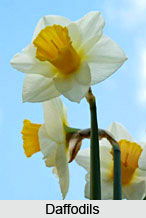 Daffodils: The meaning of the flower Daffodil is `graciousness`. The inspiration for the name is thought to come from the poisonous or narcotic effects of the bulbs or from the myth about a boy of the same name who drowned while stunned with respect of his own reflection in water. The daffodil has long been associated with human history. The Egyptians used bunches of the flowers in funeral wreaths, and the Romans raised the plants in greenhouses for the decoration of upper class homes and to add grace to banquets. There are different names of Daffodils such as jonquil, Narcissus. In the past it has been common practice to use the term Daffodil when speaking of the most familiar ones the larger trumpet and large-cupped kinds.
Narcissus was reserved for the less commonly known, smaller-flowered and bunch-flowered types. Now the trend is to recognize that Narcissus is the botanical name for all these flowers, but at the same time to realize that it`s quite acceptable to use the common and popular term Daffodil for all the others on these springtime flowers. Daffodil generally refers to the common large yellow trumpet types. Jonquil is reserved for the species N. jonquilla, which has long, narrow leaves and multiple small flowers with small cups. The Daffodil is March`s Birth Flower. The Daffodil is used prominently for decorating during the Chinese New Year in both China and festivals celebrating this holiday around the world. The Daffodil is also the flower of Wales. St. David`s Day is celebrated in Wales on March 1st and Daffodils are often worn for that holiday.
Trumpet daffodils feature a cup that is as long, or longer, than the petals, while large-cupped daffodils have cups that are more than one-third, but less than the length of, the petals. Small-cupped daffodils have cups no more than one-third the length of the petals. Triandrus daffodils produce two to six blooms per stem, with curled-back petals and short cups. Daffodils are poisonous to most animals and insects take your pick. At any rate the daffodil, is a native of central Europe and the Mediterranean region, was beloved by the Greeks and often mentioned in their literature. Daffodil flowers have a trumpet-shaped structure set against a star-shaped background; often the trumpet is a contrasting color from the background.
There are thousands of varieties of Daffodils, separated into eleven different divisions depending on blossom type. Large yellow Daffodils are the most common and popular one`s. Varieties of Daffodils come in all shades of yellow and white, but some have green, orange, apricot, pink, or crimson coloring. Most Daffodils have a clean, sweet scent, but some, such as the white narcissus Ziva, can be almost overpowering.