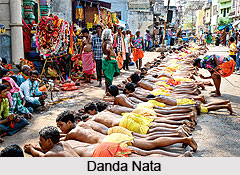
 Phases of Danda Nata
Danda Nata distinctly comprises of three phases. The first phase is of The Bhumi or Dhuli Danda and it contains acrobatic & gymnastic steps, which are performed during daytime. The second phase is of the Pani Danda, which means the performance of aquatic feats during daytime. And third phase is The Danda Suanga, where the dance, music & drama steps are performed during the night.
Phases of Danda Nata
Danda Nata distinctly comprises of three phases. The first phase is of The Bhumi or Dhuli Danda and it contains acrobatic & gymnastic steps, which are performed during daytime. The second phase is of the Pani Danda, which means the performance of aquatic feats during daytime. And third phase is The Danda Suanga, where the dance, music & drama steps are performed during the night.
(1) The Bhumi or Dhuli Danda It comprises of a lot of physical exercises and acrobatic techniques. The theme, in short sequences represent mainly the art of ploughing, cultivation and harvesting. A few formations through human figures like pyramids are displayed. Generally, the performance of Bhumi Danda is come on end by the afternoon and the `Bhoktas` yell "Kala Rudramani Ho Joy" and proceed to the village pond for the next phase.
(2) Pani Danda: This phase primarily consists of aquatic feats. Here, the group members show their performance as they swim and form pyramids in water, whereas the musicians play dhol & mohuri. Villagers gather around the pond or the riverside to watch these skills. After this performance, the `Bhoktas` return to their camp to have their only meal of the day and prepare for the next performance, to be held at night.
(3) Danda Nata Suanga: In a Danda Nata, every character takes entry in the dance with the accompanying music and gives his introduction, description of what the character is all about. He does this along with his costume, by even giving a description of his way of walking and make-up, while he sings or he dances. During a dialogue also the dance actions are corroborated in between the dialogues. Both the speaker and the listening character dance vigorously, in a course of the performance. This pattern is a regular feature of the Danda Nata, which characterizes its identity from other types of performing arts. The presentation of the Danda Nata performance is very simple as that of any common `Jatra` of Orissa except the stage that they do not need a raised platform in the center. Any open space or the village crossroad turns out to be an acting area, surrounded by spectators on all the sides.
The chief accompanying musical instruments in a Danda Nata is the Dhol, a double-sided drum and the mahuri, a wind instrument like shehnai. The other instruments, which are used only in sequences of God characters, are the ghanta (bell metal disc), sankha (conch-shell), kahali (Clarion) and the Johanna Brass alloy clappers. Apart from these, other smaller instruments like ghungroo, ghagudi (small & big tinklers), dasakathi, ram tali (wooden clappers), khanjani, ghooduki or dhuduki are also used. The characters themselves as per requirements also play Dambaroo and bina etc. The Bina used by the character "Binakara" in Danda Nata is not the type of "Bina" (the string instrument) known popularly in case of musical instruments. The player Binakara holds the Bow in his left hand raised and gives jerks gently that brings out the jingle in the rhythm and music is played out of it.
The musicians sit at a side of an open arena nearer to the passage of artists. With playing music they also turn to the Vesha Ghara (Screen Room) to lead a character to the arena. The drummers not only play the drums through out the performance but also illustrate their own skill and stamina by playing the drums with regular dances and acrobatics in between the sequences.