Dagoba
|
Dagoba is a conical erection surmounting relics among the Buddhists.
|
|
|
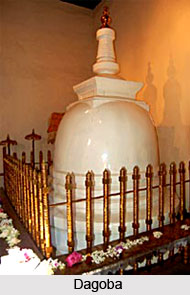 Dagoba is a conical erection surmounting relics among the Buddhists. The name Dagoba is said to have derived from da, datu or dhatu an osseous relic and geba or garbha, the womb. Dagobas are sometimes of immense height, of circular form and composed of stone or brick, faced with stone or stucco. Dagobas are built upon a platform, which again rests upon a natural or artificial elevation, which is usually reached by a flight of steps. Dagoba is a conical erection surmounting relics among the Buddhists. The name Dagoba is said to have derived from da, datu or dhatu an osseous relic and geba or garbha, the womb. Dagobas are sometimes of immense height, of circular form and composed of stone or brick, faced with stone or stucco. Dagobas are built upon a platform, which again rests upon a natural or artificial elevation, which is usually reached by a flight of steps.
The utmost respect is felt for Dagobas among the Buddhists mainly because they contain relics of different kinds. The most conspicuous contents Dagoba are generally vessels of stone or metal of various shapes and sizes. Some of them have been fabricated on a lathe. The Dagobas commonly contain a silver box or casket and within that or sometimes by itself a casket of gold. This is sometimes curiously wrought. These vessels are studded sometimes with a row of rubies. The upper and lower edge of the vessel and the bottom is also chased with the leaves of the lotus and the vase had no cover.
These vessels or sometimes the cell in which they are placed contain some small pearls, gold buttons, gold ornaments, beads, pieces of white and coloured glass and crystal, pieces of clay or stone with impressions of figures, bits of bone and teeth of animals of the ass and goat species. These vessels in the Dagobas may also contain pieces of cloth, folds of Tuz or leaf or rather the bark of birch on which the Hindus formerly wrote. These pieces bear sometimes characters which are too fragile and in decayed state to admit of being unfolded or read.
The principal Dagobas is found in Ceylon. The Nepalese consider taking a round of Dagoba to be a very holy task. Showing any kind of disrespect to the Dagoba is regarded as being highly criminal. There is a legend regarding this Dagoba. It is said that a king in Ceylon while riding a chariot accidentally struck one of these edifices of Dagobas and displaced some of the stones. When the priests in attendance rebuked him for the act the monarch immediately descended to the ground and prostrated himself in the street. He then said that they might take off his head with the wheel of his carriage. But the priests replied that their divine teacher does not like torture so he should rather repair the Dagoba. Thereafter, the monarch offered 15,000 of the silver coins called kahapana to the Dagoba.
The ground, on which a Dagoba stands, is highly regarded as the Buddhists have worshipped this for a long time and their remnants are also regarded very holy. It is believed that offering of a Dagoba is an act of the highest virtue. It is said that this offering rewards one both in this world and the next, which leads to the attainment of Nirvana or annihilation. Some of the Dagobas are alleged to have the power of working miracles. But this is to those which have been built in honour of the 'rahats' or beings who are free from all evil desire and possess supernatural powers.
|
|
|
|





