|
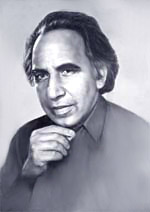 Balwant Gargi was a noted Punjabi playwright. He was born in Bhatinda. Balwant Gargi studied English literature and participated in theatre as a student. He taught acting and production in the USA in 1964-6. In 1968, he became the first director of the Department of Indian Theatre, Punjab University in Chandigarh. At that university he remained till 1976. He had a parallel career in cinema, producing Punjabi and Hindi serials, documentaries on Jatra and Ramlila, and also biographical films. Balwant Gargi was a noted Punjabi playwright. He was born in Bhatinda. Balwant Gargi studied English literature and participated in theatre as a student. He taught acting and production in the USA in 1964-6. In 1968, he became the first director of the Department of Indian Theatre, Punjab University in Chandigarh. At that university he remained till 1976. He had a parallel career in cinema, producing Punjabi and Hindi serials, documentaries on Jatra and Ramlila, and also biographical films.
Gargi's first play, Loha kutt i.e. 'Blacksmith' in 1944 became controversial for its stark picture of the Punjab countryside. At that juncture, he focused on poverty, illiteracy, ignorance, and superstition marking rural life, which continued in Saelpathar i.e. 'Petrified Stone' in 1949, Navan mudh i.e. 'New Beginning' in 1950, and Ghugi i.e. 'Dove' in 1950. In the 1950 edition of Loha kutt, he resorted to drawing poetic and dramatic elements from J. M. Synge and Garcia Lorca. In subsequent works like Kanak di balli i.e. 'Stalk of Wheat' in 1968 and Dhuni di agg i.e. 'Fire in the Furnace' in 1977, these became his chief vehicles. For all the specificity of native locale, the former deflected as much towards Lorca's Blood Wedding as the latter reminded one of Yerma. In Mirza-Sahiban in 1976, customs and conventions came in for bitter censure. Gradually, Gargi's preoccupation with sex, violence, and death became almost an obsession. Antonin Artaud's theatre of cruelty grew into his categorical imperative. This required his dramaturgy to proceed through mythopoeia, which turns explicit in his last plays.
In Saunkan i.e. 'Rival Women' in 1979, the paradigm of Yama-Yami, the Hindu god of death and his twin sister, becomes an occasion to glorify sexual union. Altogether dispensing with socio-political discourse, he turned to his new theme with a vengeance in Abhisarka i.e. 'Lover' in 1990. His penchant for the unexpected grew all-powerful.
For subject matter Gargi moved freely over social milieu, mythology, history, and folklore. For form and technique he relied as much upon Sanskrit classics as on Lorca's poetic drama, Brecht's epic theatre, or Artaud's theatre of cruelty. In the composition and performance of his dozen full-length plays and five collections of one-act drama, he traveled from the realistic to the mythopoeic mode. In addition to this dramatic corpus he has to his credit semi-autobiographical writings in English and the books Theatre in India in 1962 and Folk Theater of India 1966.
|





