


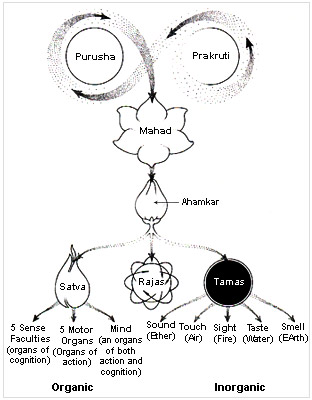
 Generally, the Samkhya system classifies all objects as falling under one of the two categories: Purusha and Prakriti. Metaphysically, Samkhya maintains a revolutionary duality between spirit/consciousness (Purusha) and matter (Prakrti). Generally, the Samkhya system classifies all objects as falling under one of the two categories: Purusha and Prakriti. Metaphysically, Samkhya maintains a revolutionary duality between spirit/consciousness (Purusha) and matter (Prakrti).
Purusha Purusha is the Transcendental Self or Pure Consciousness. It is absolute, independent, free, imperceptible, unknowable, above any experience and beyond any words or explanation. It remains pure, "non-attributive consciousness ". Purusha is neither produced nor does it produce. Prakriti Prakriti is matter. Matter is inert, transient, and unconscious. It is made up of three qualities (gunas) equivalent to creation, sustenance, and destruction. They comprise: sattva (goodness) - pure, elevating, enlightening rajas (passion) - incites one to create, acquire and enjoy tamas (ignorance) - dirty, demeaning, deceiving, and destructive. All physical events are considered as manifestations of the evolution of Prakrti, or primal Nature (from which every physical body is derived). Each sentient being is a Purusha, and is unbounded and unrestricted by its physical body. Samsaara or bondage arises when the Purusha does not have the discriminative knowledge and so is misguided as to its own identity, confusing itself with the physical body - which is in fact an evolute of Prakriti. The spirit is liberated when the discriminative knowledge of the difference between conscious Purusha and unconscious Prakriti is realised. Ishvara (Creationist God) The original school of Samkhya was founded by Sage Kapila. There was no philosophical berth for a creationist God in this system. The Samkhyan's argue that the existence of Ishvara cannot be testified and hence cannot be admitted to exist. The school also debates that an unchanging Ishvara as the cause cannot be the source of a changing world as the effect. Later on followers of Samkhya adopted theism and included Ishvara within the system. The concept of Ishvara was contained into the Samkhya viewpoint only after it became associated with the theistic Yoga system of philosophy. |
| |||



Home > Reference > Indian Philosophy > Schools of Indian Philosophy > Samkhya Philosophy > Metaphysics In Samkhya Philosophy
Metaphysics in Samkhya Philosophy
| Samkhya system classifies all objects as falling under one of the two categories:; Purusha and Prakriti. |
| ||||||||||||||||||||||||||||

