





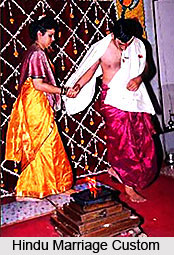
 Indian marriage customs are really diversified. In India, the marriage customs differ as per the beliefs of different religions and also from one region to another. Whatever may be the region or caste; the marriage customs are followed dedicatedly in India. Like for instance, Hindu marriage rituals differ from Muslim wedding rituals and they again vary from Sikh wedding rituals, etc. In India, different communities of the society have their own way of organising the most important occasion. The wedding rituals are broadly divided according to the religions. Indian marriage customs are really diversified. In India, the marriage customs differ as per the beliefs of different religions and also from one region to another. Whatever may be the region or caste; the marriage customs are followed dedicatedly in India. Like for instance, Hindu marriage rituals differ from Muslim wedding rituals and they again vary from Sikh wedding rituals, etc. In India, different communities of the society have their own way of organising the most important occasion. The wedding rituals are broadly divided according to the religions.
Some of the popular Indian marriage customs are mentioned below - Hindu Marriage Rituals In Hindu marriage ceremonies, there are pre-marriage and post marriage wedding rituals. It includes Sangeet Ceremony, Mehendi ceremony, Tilak Ceremony, Barat Nikashi, Mamara, Vara Satkaarah, Madhuparka Ceremony, Kanya Dan, Parikrama, Pradakshina, Mangal Fera, Saptapadi, Dwar-Rokai, Griha Pravesh and Mooh Dikhai are some of the main rituals of Hindu Marriage traditions. Solah Shringar for bride on the wedding day is one of the most exciting aspects of her life. The full adornment consists of sixteen parts from head to toe and is thus called 'Solah Shringar'. In ancient Hindu societies, practice of Swayamvarawas very common. The Baarat Nikashi is the rejoicing ritual of the Indian wedding when, the groom arrives at the bride's house. 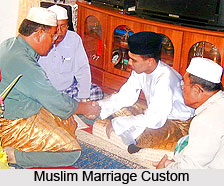 Procession of the bridal pair along the main streets of the village is one of the customs that are peculiar to the Hindus. The sacred symbol of wedlock, Mangalsutra is an unavoidable part in Indian Hindu weddings. Each and every ritual and custom involved in marriage impersonates the real essence of wedding. Marriage with trees, plants and inanimate objects are quite common instances in the ancient Hindu society. Procession of the bridal pair along the main streets of the village is one of the customs that are peculiar to the Hindus. The sacred symbol of wedlock, Mangalsutra is an unavoidable part in Indian Hindu weddings. Each and every ritual and custom involved in marriage impersonates the real essence of wedding. Marriage with trees, plants and inanimate objects are quite common instances in the ancient Hindu society.
Muslim Marriage Customs 'Nikah' is the most significant Muslim marriage ritual. In Muslim wedding too, the rituals are divided in pre-marriage, marriage and post-marriage rituals. Each ritual differs from one another. The post-marriage rituals in Islam are categorised into four different phases, where the bride bids goodbye to her family and it is followed by her welcome by the groom's family to her new home. Christian Marriage Rituals 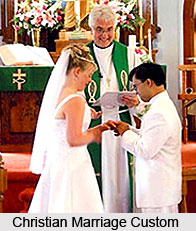 Christian marriages usually take place in Church, in front of a priest. Traditional white gown is the worn by the bride, with a white veil covering her head. As per the rituals of Christian wedding actual wedding rituals begin after both the groom and the bride comes to the altar. During this entire proceeding hymns are sung by the choir. It is followed by readings from the Bible. The priest then gives the rings to the couple and after that the groom and the bride exchange the rings. Subsequently, they are declared as husband and wife.
In a Jain wedding some of the main rituals include Phere, Havan and Granthi Bandhan. According to the Indian wedding customs, the seating position has been the groom on the right and bride on the left. Since ages this has been the practice in all Indian marriages. Sikh Marriage Ceremonies and Christian Marriage Ceremonies follow this practice rigidly. It is believed to be auspicious if the bride sits to the left of the groom. However, with passing days many ceremonial regulations are altered. Although with passing eras, there have been vast changes in the Indian marriage scenario, but the core ethics and traditions still hold the same position. The Indian marriage customs are some of the richest collections of social rituals in the whole world. |
| ||||||||||||||||||||||||||||

