


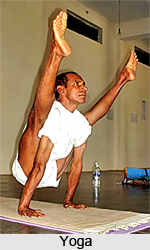
 Ashtanga Yoga or the eightfold path leads one to Samadhi. In the second chapter of Yoga Sutras, Sadhana Pada, Maharashi Patanjali mentions these eight steps to achieve Samadhi. In order to achieve success through Ashtanga Yoga, one must abide by the eight rules, namely Yama, Niyama, Pranayama, Pratyahara, Dharana, Dhyana and Samadhi. In Sanskrit "Ashta + anga" creates Ashtanga; where "Ashta" means Eight and "Anga" refers to limbs, thus, meaning Eight Limb path. Ashtanga Yoga or the eightfold path leads one to Samadhi. In the second chapter of Yoga Sutras, Sadhana Pada, Maharashi Patanjali mentions these eight steps to achieve Samadhi. In order to achieve success through Ashtanga Yoga, one must abide by the eight rules, namely Yama, Niyama, Pranayama, Pratyahara, Dharana, Dhyana and Samadhi. In Sanskrit "Ashta + anga" creates Ashtanga; where "Ashta" means Eight and "Anga" refers to limbs, thus, meaning Eight Limb path.
The 'Ashtanga Yoga' series is said to have first revealed in an ancient text called the 'Yoga Korunta', compiled by Vamana Rishi, which Krishnamacharya received from his Guru Rama Mohan Brahmachari on Mount Kailash. This chapter initiated a series of physically demanding practice, which can be successful at channeling the hyperactivity of the restless minds. This system is used as a vessel for calming the continuing babble of the mind and it gradually reduces stress too. Yama, the first path in Ashtanga Yoga, refers to code of conduct or self-restraint. Yama comprises five parts: Ahimsa (non-violence), Satya (truthfulness), Asteya (non-stealing), Brahmacharya (celibacy), and Aparigraha (non-avariciousness). Ahimsa also signifies perfect harmlessness and positive love. This removes the cruel nature of man and strengthens his will. The five directives of Yama have scientific base as well. These establish the behavioural customs as requirements for elimination of fear and anguish and contribute to a serene mind. Non-violence (ahimsa), truthfulness (satyavachana), non-stealing (astheya), celibacy (brahmacharya), and moderation in setting goals (aparigraha), prevent situations that enkindle fear in human interactions and contribute to peace of mind. Ahimsa (non-violence) helps to ban conflicts with fellow beings that generally occur because of competition for consuming and conjugation. Satyavachan (truthfulness) helps in establishing peace of mind by extinguishing fear of discovery of lies. Astheya (non-stealing) extinguishes the anxiety of discovery of theft, potential payback by the owner and punishment by state. Brahmacharya (celibacy or stage of life devoted to seeking knowledge) debars conflict associated with search for mates, extinguishes fear of strife, enhances scholarship and upgrades composure. Aparigraha (moderation in setting goals) prevents the anguish of potential failure, promotes self-control and poise. Niyama, the second limb of Ashtanga yoga, are the religious observances and dedications to practice, like study and devotion. Niyama is observance of five principles: Shaucha (internal and external purity), Santosha (contentment), Tapas (austerity), Svadhyaya (study of religious books and repetitions of Mantras), and Ishvarapranidhana (self-surrender to God, and His worship). It is said that he who practices meditation without ethical perfection and without the practice of Yama-Niyama cannot get the fruits of meditation. One needs to purify the mind first through the practice of Yama - Niyama. Later, it is advised to practice regular meditation and go for Ashtanga Yoga. Only then, one can attain illumination. Yoga Asana is said to be the consolidation of mind and body through physical activity. It is a very important part of Ashtanga Yoga. Asanas stabilise the body. Posture is mastered by discharging tension and meditation on the unlimited. Asana and Pranayama together recognise the intimate connection between body and mind. Asana are a series of gentle physical exercises projected to keep the muscles in tone, the joints supple and nerves in tune. Yoga Asanas also help in balancing and harmonising the basic structure of the physical human body, which is why they have a range of therapeutic uses too. Asanas basically perform five functions, namely Conative, Cognitive, Mental, Intellectual and Spiritual. Conative action is the voluntary exercise of the organs of action. The asanas being the main yogic instrument of balancing the body comprises various physical postures, which are designed to release tension, improve elasticity and maximize the flow of vital energy. 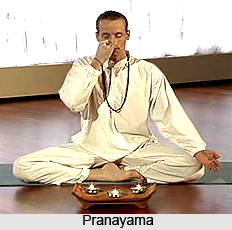 The purpose of the asanas is to create a flow of positive energy so that the concentration is directed within the body and the mind can perceive (parokshya jnana) the effects of the purposive action. The resultant rhythmic energy flow leads to a mental state of pure joy (ananda). Asanas affect the various interrelated channels (nadis) of the mind-body complex. The purpose of the asanas is to create a flow of positive energy so that the concentration is directed within the body and the mind can perceive (parokshya jnana) the effects of the purposive action. The resultant rhythmic energy flow leads to a mental state of pure joy (ananda). Asanas affect the various interrelated channels (nadis) of the mind-body complex.
Pranayama is the regulation of breath leading to consolidation of mind and body. Pranayama controls the outgoing tendencies of the mind. It is often misunderstood for breathing exercises. 'Prana' means life force, whereas 'Yama' means to gain control. Pranayama is the prelude to concentration of mind. Pranayama brings the involuntary breathing cycle under voluntary control by regularising inhalation, exhalation and holding breath static - either in the lungs or out of them for periods, which could be long or short. Active regulation of breathing naturally requires concentrating on the process, a prelude to restraint of thinking process, and the final goal of Raja yoga. Pratyahara means abstraction of the senses, detachment of the senses of perception from their objects. Pratyahara is probably the basic idea of Ashtanga Yoga that refers to the renunciation of worldly attractions. Pratyahara gives inner spiritual strength. It removes all forms of distractions and develops will-power. The objective of Pratyahara is to disrupt the communication from the sense organ to the brain. Light, sound, smell and other stimuli received by the sense organs are barred from the brain centers and, thus, cannot distract the concentration of the mind. Dharana, another limb of Ashtanga yoga, depicts concentration of mind. It is said that real yoga begins from concentration. Concentration unites into meditation. Meditation ends in Samadhi. Retention of breath, Brahmacharya, Sattvic (pure) food, seclusion, silence, Satsanga (being in the company of a guru), and not mixing much with people prove helpful for concentration. It is further advised to concentrate on Trikuti (the space between the two eyebrows) with closed eyes. The mind can, thus, be easily controlled as this is the seat for the mind. Dhyana is meditation (quiet activity that leads to samadhi). Sleep, subtle desires and cravings, agitation of mind, attachment to objects, sloth, lack of Brahmacharya, gluttony are all hindrances in meditation. It is best to reduce one's desires and cultivate detachment. By doing this, one will have progress in Yoga. Vairagya thins out the mind. Thus, it is advised to not to do anything in excess. One should never grapple with the mind during meditation. One should also not use any violent efforts for concentration. If evil thoughts enter the mind, it is advised not to use one's will in driving them. In the process, one will tax one's will, lose energy and will fatigue oneself. The greater the efforts one make, the more the malicious thoughts will return with intensified force. One should always try to be indifferent. It is best to become a witness of those thoughts, to substitute them with divine thoughts until they pass away. However, one should never miss a day in meditation. Regularity is of paramount importance. When the mind is tired, it is best to not concentrate. It is best not take heavy food at night. Ashtanga yoga also states that the mind passes into many conditions or states as it is made up of three qualities - Sattva, Rajas and Tamas. Kshipta (wandering), Vikshipta (gathering), Mudha (ignorant), Ekagra (one-pointed), and Nirodha (contrary) are the five states of mind. By controlling the thoughts, the Sadhaka accomplishes great Siddhis. He becomes a virtuoso. He attains Asamprajnata Samadhi or Kaivalya. It is advised here to never run after Siddhis. Siddhis are enormous temptations. They will bring about one's downfall. A Raja Yogi practices Samyama or the combined practice of Dharana, Dhyana and Samadhi at one and the same time and gets detailed knowledge of an object. One should try to control the mind by Abhyasa (practice) and Vairagya (dispassion). Any practice, which stabilises the mind and makes it one-pointed is 'Abhyasa'. Dull Vairagya will not help one in attaining perfection in Yoga. For this one must attain Para Vairagya or Theevra Vairagya (intense dispassion). 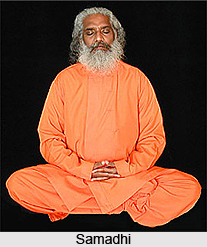 Samadhi is the quiet state of idyllic awareness and super-conscious state. Meditation on 'OM', realizing the Bhava and its meaning, removes hindrances in Sadhana and helps the person to attain Samadhi. Avidya (ignorance), Asmita (egoism), Raga-Dvesha (likes and dislikes), Abhinivesha (adhering to mundane life) are the five Kleshas or afflictions. It is advised to destroy these afflictions to attain Samadhi. Samadhi is of two kinds, namely Savikalpa, Samprajnata or Sabija; and Nirvikalpa, Asamprajnata or Nirbija. In Savikalpa or Sabija, there is Triputi or the trinity (knower, known and knowledge). The samskaras are not burnt or freed. Savitarka, Nirvitarka, Savichara, Nirvichara, Sasmita and Saananda are the different forms of Savikalpa Samadhi. In Nirbija Samadhi or Asamprajnata Samadhi there is no trinity. A Bhakta gets Bhava - Samadhi, a Jnani gets Badha - Samadhi and a Raja Yogi achieves Nirodha Samadhi. Realising the Bramhan (pure consciousness) or Realisation of God is said to be the final achievement of human birth.
In contemporary days, Ashtanga Yoga has earned immense popularity worldwide. Many yoga institutes offer Ashtanga classes in India. Once students know the order of poses very well, they may often go for self-led style of practice. Ashtanga is also an ideal foundation for home practitioners, once they know the sequence of poses. Ashtanga yoga has become extremely popular, owing to its vigorous, athletic style of practice. This style of Yoga appeals those who prefer a sense of order and who like to do things independently. |
| |||



Ashtanga Yoga
| Ashtanga Yoga is a vital aspect of Patanjali Yoga Sutra that comprises the eight-fold paths to salvation. |
| ||||||||||||||||||||||||||||

