|
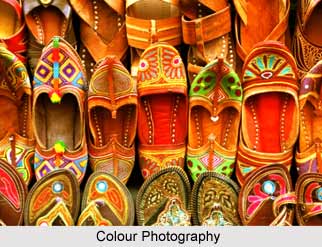 The Authochrome process, introduced in France in 1907 by Auguste and Louis Lumiere, was the first practical colour photography process. It used a colour screen (a glass plate covered with grains of starch dyed to act as primary-colour filters and black dust that blocked all unfiltered light) coated with a thin film of panchromatic (i.e., sensitive to all colours) emulsion, and it resulted in a positive colour transparency. However, Autochrome was a colour transparency and could be viewed only by reflected light. Researchers although continued to look for improvements and alternative colour improvements. In 1935 Leopold Godwsky Jr. and Leopold Mannes, two American musicians working with the Kodak Research Laboratories, initiated the modern era of colour photography with their invention of Kodachrome film. The Authochrome process, introduced in France in 1907 by Auguste and Louis Lumiere, was the first practical colour photography process. It used a colour screen (a glass plate covered with grains of starch dyed to act as primary-colour filters and black dust that blocked all unfiltered light) coated with a thin film of panchromatic (i.e., sensitive to all colours) emulsion, and it resulted in a positive colour transparency. However, Autochrome was a colour transparency and could be viewed only by reflected light. Researchers although continued to look for improvements and alternative colour improvements. In 1935 Leopold Godwsky Jr. and Leopold Mannes, two American musicians working with the Kodak Research Laboratories, initiated the modern era of colour photography with their invention of Kodachrome film.
Yet, for the most surprising part, during the good part of the last century, besides professionals and enthusiasts, India could not boast of common men possessing a coloured film camera or photographers. The sale of even an amateur coloured film camera was appalling for several decades, because of the simple reason that they were beyond the reach of many Indians. The SLRs were unthinkable, as they were too pricey. Both amateur models and SLRs were either sourced from grey markets, second sales to foreign trips. The government saw to it cameras did not reach the common men by its system of tax excesses. People back then had only to pacify their thirst for coloured panorama by merely using the Orwo model of camera in black and white photography.
When Sakur became Konica during the early 1980s to tap the mass market (which did not exist), one saw the slow sprouting of colour labs by the roadways. Taking one's studio portrait was seen as a lifetime experience by several individuals and families. The entry of Konica, however, changed all that. Its films came as a boon not only to the budding photo enthusiasts, but also to the wedding photographers, who simply fell for the advantages Konica offered in terms of colour biases (in favour of the colourful Indian weddings) such as an overt green tone. Konica films were available for Rs. 130 to begin with and Kodak was too pricey at Rs. 150. However, in the upcoming years the market witnessed further lowering of price. But there was no fun to possess an affordable film brand, where the cameras were highly unaffordable. They had to be obtained after much hassles from the grey market vendors. It was only during the late 1980s and the early 1990s that the price was reduced in the common market and it began to be distributed evenly.
Since its massive evolvement in the 1990s, colour photography is seen escalating the graph of triumph in the country. Colour is the basis of every kind of photography that is under use today. It is the language of the common man through pictures and images.
Be it during marriages, or in festivals, or during pujas, or in various kinds of exhibitions, colour speaks for itself when one views a picture. The present times, or the late 1990s, witnessed colour photography being brought into every middle class home, being treated as a toy of wonder. Suddenly photography was the basis of study of every individual, and it was during this era of the late 20th century that one noticed the budding of numerous ace photographers, many of who have already made a name for themselves in their personal genres. The scope is thus already an established area, which is rising further. With the advent of the digital camera, however, the growth had received a blow. But that can just be regarded as a passing phase, because photographers still swear by the extensive process of a coloured film roll and its capturing in the camera, and finally developing it according to one's wish.
|





