|
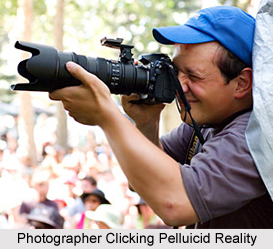 A camera is a device used to capture images, either as still photographs or as sequences of moving images (movies or videos). The term camera comes from the Latin camera obscura, meaning 'dark chamber', standing for an early mechanism of projecting images where an entire room functioned as a real-time imaging system; the modern camera evolved from the camera obscura. Cameras may work with the light of the visible spectrum or with other portions of the electromagnetic spectrum. A camera normally consists of an enclosed hollow with an opening (aperture) at one end for light to enter, and a recording or viewing surface for capturing light at the other end. Majority of the cameras have a lens positioned in front of the camera's opening to assemble the incoming light and focus all or part of the image on the recording surface. The diameter of the aperture is often mastered by a diaphragm mechanism, but some cameras have a fixed-size aperture. A camera is a device used to capture images, either as still photographs or as sequences of moving images (movies or videos). The term camera comes from the Latin camera obscura, meaning 'dark chamber', standing for an early mechanism of projecting images where an entire room functioned as a real-time imaging system; the modern camera evolved from the camera obscura. Cameras may work with the light of the visible spectrum or with other portions of the electromagnetic spectrum. A camera normally consists of an enclosed hollow with an opening (aperture) at one end for light to enter, and a recording or viewing surface for capturing light at the other end. Majority of the cameras have a lens positioned in front of the camera's opening to assemble the incoming light and focus all or part of the image on the recording surface. The diameter of the aperture is often mastered by a diaphragm mechanism, but some cameras have a fixed-size aperture.
History of Camera: The first camera that was small and portable enough to be practical for photography was built by Johann Zahn in 1685, though it would be almost 150 years before technology caught up to the point where this was useful. Early photographic cameras were essentially similar to Zahn's model, though normally with the addition of sliding boxes for focussing. Before each exposure, a sensitised plate would be inserted in front of the viewing screen to record the image. Jacques Daguerre's popular daguerreotype process utilised copper plates, whereas the calotype process was invented by William Fox Talbot recorded images on paper.
|
|
|
|
|
|
|
|
Recently Updated Articles in Indian Photography
|
|
|
| • | Adventure Photography
It`s a niche defined by stunning landscapes, lively personalities, challenging, and ever-changing shooting conditions.
| | | • | Styles in Monochrome Photography
With the enlargement of digital technology, monochrome photography became easier today than ever earlier it was.
| | | • | Indian Photographic Studios
Indian photographic studios provide resources and services to almost every kind of photographer. Photography comes in handy in capturing moments from lives.
| | | • | Nature Photography in India
Capturing the beauty of nature, the natural scenes and the rich textures outdoors is what constitutes nature photography.
| | | • | Landscape Photography in India
A landscape is a land with aggregate natural features and the photograph of the same is known as Landscape Photography.
| | |
|
|
|
|
|





