 Indian Wedding Acts lay down the fundamental guidelines to be followed for marriage in India. Marriage acts in India came into force in 1955 that contains Indian Wedding Laws, Defence Marriage Acts, Marriage Protection Acts and Federal Marriage Act. There are also various rules and regulations for different religions like Hindu Marriage Act, Muslim Marriage Act, and Christian Marriage Act and for the Parsi there is Parsee Marriage and Divorce Act.
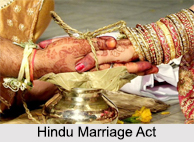
Hindu Marriage Act
The Hindu Marriage Act of 1955 is relevant to Hindus, Jains, Sikhs and Buddhists. A religious marriage, which has already been solemnized, can be registered under the Hindu Marriage Act, 1955. The Hindu Marriage Act is appropriate in cases where both husband and wife are Hindus, Jains, Sikhs or Buddhists or in case they have transformed into any of these religions. The Hindu Marriage Act offers for the conditions of a marriage where under the bridegroom should be the age of 21 years and bride of 18 years; they both should not be within the extent of prohibited relationship.
 Special Marriage Act
The Brahmo Marriage Act of 1872 was repealed by the Special Marriage Act, 1954 under which any person of any religion could marry. The Special Marriage Act was endorsed to provide a special form of marriage for any individual in India and all Indian nationals in foreign countries without discriminating their the religion or faith pursued by either party to the marriage. The parties may survey any ceremonies for the solemnization of their marriage but some particular formalities are approved before the marriage officer. This Act is pertinent throughout the country except the state of Jammu and Kashmir.
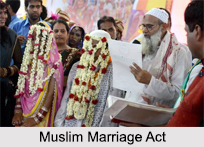
Muslim Marriage Act
Muslims also have their own personal law, which states that "Nikah" or marriage is a contract and may be permanent or temporary and permits a man four wives if he treats all of them equally. In the Muslim Marriage Act, registration of the marriage is not compulsory. The Kazi who has performed the marriage can issue a Nikahnama which is a marriage certificate.
Christian Marriage Act
The law regulating solemnisation of marriages among Indian Christians is laid down in the Indian Christian Marriage Act of 1872. It was the British-Indian administration that enacted the law. The Act stated that every marriage in India between persons, one or both of whom are Christian, shall be solemnised in accordance with the provisions of the Indian Christian Marriage Act.
Parsi Marriage and Divorce Act
 The Parsi Marriage and Divorce Act were passed in 1865. It is expedient to amend the law relating to marriage and divorce among Parsis.
An NRI, a PIO or a Foreigner including the Americans, Canadians, British and others can marry in India has the choices like Religious Marriage Ceremony or Civil Marriage Ceremony. The religious marriage ceremonies in India are considered to be legal marriages.
Marriage Laws in India
Marriage Laws in India brought about important changes in the law on this subject prevailing earlier. Most of the Indians are unaware of the laws associated with Indian marriages. Although marriage is a social event, registration of marriage is now a legal requirement in most of the states in India. Moreover, for visa and immigration purposes a formal marriage certificate from the Registrar of Marriages is required.
India is a multi-ethnic country and has initiated many personal laws of its citizen. As the result of marriage laws in India, each citizen of the country is entitled to have his own personal law in the matter of marriage and divorce.