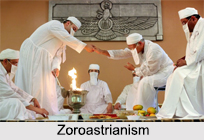
About 300 years ago the Parsi settlers migrated from the towns and villages of Gujarat to Mumbai. Gradually from a predominantly agricultural community, it became a highly urbanized one. The Parsis came to play a leading role in transforming Mumbai into a busy and prosperous port. Among the several Parsis employed in the East India Company`s dockyard at Surat was Lowjee Jusserwanjee who was so efficient in supervising the building of a ship, the Queen, that he was called to Mumbai to establish a building yard. There he laid the foundation of an establishment, which came to be considered the finest naval arsenal in the subcontinent.
A scion of the Wadia family, master builder Nowrojee, built the Hugh Lindsay, the first steamer in Mumbai to make the voyage to Suez and back in record time. On the day he died after 52 years of meritorious service the British Commodore ordered the dockyard to be closed and flags to be flown at half-mast on all vessels in the harbour, the only recorded instance when a private individual was so honoured.
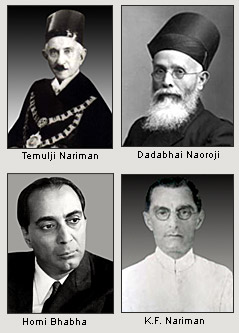
The Parsis were also among the first to open up extensive trade in their own Indian ships with China, making and sharing large fortunes. Nearer home the Parsis took a decisive lead in industry by establishing cotton spinning and weaving mills in the latter half of the nineteenth century, several cotton and ginning factories and the earliest import and export firms. They were in the vanguard of the fight for the amelioration of the lot of mill labour and the control of child labour. Sorabji Pochkhanawala conceived the idea in 1811 of a banking institution, wholly Indian in outlook and approach, with the development of indigenous enterprise as its main objective. The well-known doctor, Temulji Nariman, founded the first maternity home in Bombay.
 The Parsis played a notable part in building Bombay where many institutions, statues and roads bear Parsi names. Under the inspiration of men like, Pherozeshah Mehta, the growing city directed its energies to those primary tasks of civic administration which, when fulfilled, made it India`s fitst city. R.P. Masani was the first Indian mayor and the first municipal commissioner to establish the supremacy of the civic body by clearly defining and demonstrating the commissioner`s constitutional position as government`s agent vis-a-vis that of the municipal corporation.
Rustomji Cawasji Banaji migrated to Kolkata with his family in 1838 and grew to be a merchant prince of that city. He bought the Calcutta Docking Company and together with his sons came to own twenty-seven ships in all, fifteen of which were chartered by the British government during the Chinese wars. He also founded an aviary at Calcutta and was one of the twelve justices of peace appointed by the Calcutta government in 1835. Another scion of the Banaji family, Maneckshaw Rustomji Banaji, became the first Indian sheriff of Calcutta in 1873.
Dadabhai Naoroji, K.F. Nariman, (Dt.) M.D. Gilder and M.R. Masani are some of the eminent Parsis from the Indian political scenario. India`s first atomic energy establishment, located in Bombay, is named after Homi Bhabha, the great Parsi scientist who was its inspiration and head. The Tata Memorial Hospital, founded in 1931 for the systematic study and treatment of cancer is another Parsi contribution. Parsis have served with distinction in the army, navy and air force as well. Today Tata and Godrej are household names.