


 The visesa avisesa lihgamdtra alihgani gunaparvani sutra states about the gunas and their significant divisions in nature. Nature, with its three qualities of luminousness - action, motion and inertia lends the most important qualities in human birth cycles by governing from the previous actions. The human counterpart of cosmic nature- the mind is also made up from the fundamental distinguishing faculties that helps one in reasoning. And when nature with all its attributes mingles with the individual, divine intervention takes place. The visesa avisesa lihgamdtra alihgani gunaparvani sutra states about the gunas and their significant divisions in nature. Nature, with its three qualities of luminousness - action, motion and inertia lends the most important qualities in human birth cycles by governing from the previous actions. The human counterpart of cosmic nature- the mind is also made up from the fundamental distinguishing faculties that helps one in reasoning. And when nature with all its attributes mingles with the individual, divine intervention takes place.
visesa the art of distinguishing or discriminating, a state of being especial, a mark avisesa uniform, alike, without any difference, unspecified state lihgamatra indicator, mark, sign (chief mark or indication of prakrti, i.e., the cosmic intelligence - mahat), phenomenal, directly apprehended, observed alihgani without mark, without sign, non-primary matter or un-evolved matter, unknown and unknowable substance or thing as it is in itself, the noumenal gunaparvani changes in qualities The gunas generate their characteristic divisions and energies in the seer. Their stages are distinguishable and non-distinguishable, differentiable and non-differentiable. This sutra analyses nature (prakrti) by distinguishing the progressive layers of its manifestation, from the most specific and definable, up through the non-specific and non-distinguished and back to the undifferentiated or universal. To release oneself from the confines of nature, one has to be familiar with its geography and its divisions, and with how these are affected and changed by the gunas, so that one can understand the internal rules that govern nature in all its forms, however subtle. 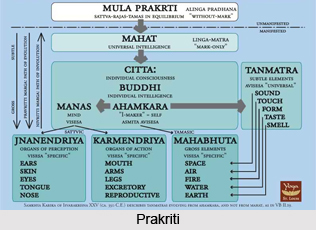
Nature (prakrti) comprises cosmic intelligence (mahat), which has the three qualities of luminosity (sattva), action and motion (rajas) and inertia (tamas). It is the changing influence of these qualities that gives form to human life in its cycle of births and shapes one's characteristics according to the quality of one's previous actions and experiences. Prakrti also manifests its energy in the character of the five elements - earth, water, fire, air and ether; and in the five subtle manifestations of smell, taste, shape, touch and sound. The individual counterpart of cosmic intelligence (mahat) is consciousness, or citta. Citta consists of mind (manas), which reviews sensory and vibrational stimuli, intelligence (buddhi), which is the discriminative faculty and ego or small self (ahamkara) which is the individual 'T'. In addition, hidden deep within man's nature is a powerful hidden spiritual weapon - 'conscience' (antahkarana or dharmendriya) which personifies ethical and moral principles. Antahkarana observes right and wrong in one's conduct and motives, helps to cultivate citta and directs it to perform only the righteous actions. There are also the five senses of perception - ears, tongue, eyes, nose and skin, and five organs of action - legs, arms, speech, genital and excretory organs. These are the principles of prakrti. The five elements, intelligence, senses of perception and organs of action are distinguishable, i.e., physically manifest in concrete form. The other parts, the five subtle manifestations of the elements and the 'T' consciousness (ahamkara, antahkarandand asmita) exist in a non-distinguishable or vibrational form, being non-primary and un-evolved matter. Yet, all these revolve around the three gunas of nature - tamas, rajas and sattva. The principles (tativas) of distinguishable elements (visesa) give rise to changes which may be pleasant, unpleasant or dazed (a state of suspended or deadened sensibility). The unspecified principles (avisesa tattvas) are un-evolved matter, and when such matter is transformed into a specified state, creation takes place. This is called pravrttimarga. The reverse process, mvnti marga, is the unifying of the specified in the unspecified, of the non-specified in and of nature into the universal spirit (purusa). The fusing of nature into spirit is a heavenly marriage, which becomes possible through the work of yoga. |
| |||



Home > Health > Yoga > Patanjali Yoga Sutras > Sadhana Pada > Visesa avisesa lihgamdtra alihgani gunaparvani
Visesa avisesa lihgamdtra alihgani gunaparvani
| This yogic sutra is contained in the second phase of the Patanjali Yoga Sutras. |
| ||||||||||||||||||||||||||||

