Painting during Shah Jahan
|
During Shah Jahan`s rule, the naturalism in the paintings became a secondary consideration.
|
|
|
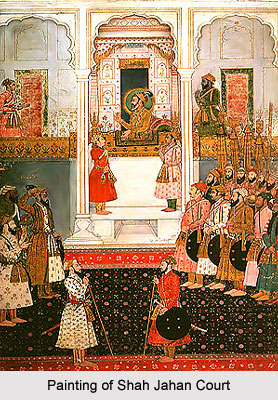 The development of Mughal kingdom was drooped when Shah Jahan took up the throne. The financial condition also became very severe. Therefore, as a sensible ruler he also neglected the Imperial studio of painting and concentrated more on other more important things. The development of Mughal kingdom was drooped when Shah Jahan took up the throne. The financial condition also became very severe. Therefore, as a sensible ruler he also neglected the Imperial studio of painting and concentrated more on other more important things.
Most of the paintings of Shahjahan's time were concentrated on the first decade of his reign. Only major manuscript done by Shah Jahan was a journal, which was all about praising his reigning period. This journal covered twenty years and in it the paintings were executed simultaneously with the texts. Despite of the financial problems, he did not cut the financial support to the painters working under his patronage.
Shah Jahan's painting studio tried to follow the rich culture of Jahangir to a considerable extent. Shah Jahan's painting albums were well known for their floral margins, which were extraordinary as well as botanically accurate but their subject matter was narrower in range. Most of the paintings were formal single portraits. For this, some of the portraits had a misleading family likeness. For example, that identified as the ambassador of the Safavid Shah Safi, Muhammad All Beg, painted by Hashim looked similar to another portrait of a Safavid official in the British Museum who might not be the same person at all. It was evident from the paintings of State occasions like Shah Jahan's accession to the throne in 1628 that his painters also readily seized any opportunity to depict figures in large groups.
The naturalism of Jahangir's paintings started becoming a secondary consideration during the time of Shah Jahan. The individualism of the European, Muslim and Hindu elements, religious, cultural and stylistic pattern of paintings made under Akbar and Jahangir were missing remarkably. This reflects Shah Jahan's greater commitment to Muslim orthodoxy and the rejection of the Hindu element in the Mughal state. For this reason, probably, Shah Jahan handed over some of the painters of his studio to his much-pampered favourite son, Dara Shikoh, who was killed in 1658. But still, the paintings of his period maintained the brilliance and gloss, the elimination of jarring features, which represented in a sense a zenith of the Mughal style
|
|
|
|





