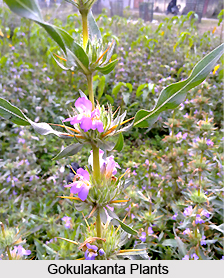
 Gokulakanta is a fleshy, coarse, prickly, somewhat tall yearly herb. The stem of the plant is lean and petite, circular, hairy and red in colour. The plant grows perpendicularly upto about 1 metre, with no branches spreading on the sides. The leaves are plain, with wavy or winding perimeters, bearing bright blue flowers. The seeds are tiny, flat, round, dark red in colour. The entire plant is covered with a delicate hair growth. The entire plant is used for medicinal purposes, especially its leaves and roots.
The roots of the plant contain a volatile oil. The seeds contain yellow semi-drying oil- i.e., the oil which has the property to dry moderately by vaporisation. They also contain diastase, lipase and protease. An alkaloid is also present in the seeds in addition to these chemical contents.
Methods of usage
Gokulakanta has ample usage in fields of dropsy, genital sickness, liver malfunction, anaemia, rheumatism, and also arouses libido.
Healing Power and Medicinal Properties of gokulakanta
The herb acts as a revitaliser and stimulant. It increases the secretion and emission of urine and boosts libido. The char of the plant serves as a brilliant diuretic. It has a cooling effect on the skin and mucous membranes.
Dropsy cured by gokulakanta
The char of the plant is useful in healing dropsy, a disease differentiated by an unreasonable accumulation of watery fluids in the tissues or cavities of the body. The char should be dispensed if possible with cow`s urine in dosages of 1.5 to 3 grams. The root is also useful in the treatment of dropsy.
Genito-Urinary Disorders cured by gokulakanta
The root of the plant is advantageous for treating gonorrhoea and urinary disorders, including swelling of the urinary tract and stone within the kidneys. The extraction can be administered in dosages of 30 to 60 grams, twice or thrice daily.
The extraction of its leaves are a surefooted medication in case of syphilis and gonorrhoea. The mucilage obtained by impregnating the seeds in water is also dictated for instances in gonorrhoea, urinary diseases and as a revitaliser.
Liver Disorders healed by gokulakanta
The roots of the plant are useful for the cure of liver disorders like jaundice and hepatitis. It is specifically utilitarian in hepatic overthrow. A decoction of the root is given in the treatment of such conditions. Approximately 60 grams of the root is boiled in half a litre of water for 20 to 30 minutes in an enclosed vessel. Approximately 30 to 60 ml of this concoction is given two or three time daily.
Anaemia healed by gokulakanta
The herb distills blood and is indispensable in the treatment of anaemia. A decoction of its root can be administered in a similar process like liver disorders.
Rheumatism cured by gokulakanta
The drug is also effectual in rheumatic miseries such as rheumatism, arthritis, and gout.
Methods for Uses and Dosages - The leaves of the plant do not possess any perceptible taste. They incorporate a cellulose that is hard. The leaves can be consumed by themselves or coalesced with the leaves of holy basil (tulsi). The juice from 20 grams of leaves can be blended with both buttermilk or coconut water and fruit juice. Two teaspoons of the pulverised leaves can also be immixed with 120 to 180 ml of buttermilk or 100 ml of water.