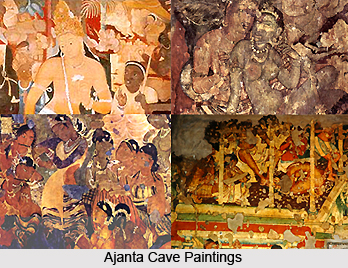
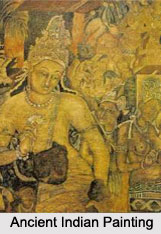
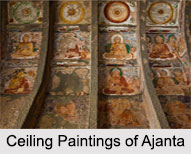
 Paintings of Ajanta caves are mainly based on the episodes drawn from the life of Lord Buddha. These paintings are regarded as some of the finest frescoes and have widened their influence worldwide. Ajanta caves are the treasure house of delicate paintings. Some of them also portray scenes from Jataka tales. Celebrated for its archaic wonder and laced with a series of carved artistry, Ajanta cave paintings echo the quality of Indian creativity in perhaps the subtlest way.
Features of Paintings of Ajanta
In Ajanta wall-paintings, there is a profound modification from the art of early Buddhism. The Ajanta paintings stress on religious romanticism with lyric quality, a reflection of the view that every aspect of life has an equal value in the spiritual sense and as an aspect of the divine. The paintings are done by covering the rough surface of the wall with a layer of clay or cow dung mixed with chopped straw or animal hair. When this has been smoothed and levelled, it is given a finish of fine white clay and it is on this ground that the painting is done.
The Ajanta wall paintings are famed for their masterful line-work, the utilization of natural pigments and the creativity achieved with only prehistoric tools. These masterpieces at Ajanta were implemented more or less in two phases. An original phase is made up mainly of the remains in caves 9 and 10, from the second century B.C. The major colours used were red ochre, yellow ochre, brown ochre, lamp black, white and lapis lazuli which was introduced from Northern India. Ceilings, walls and pilasters are all wrapped with overlying figures, brought to life by the artists with complementary colours.
Wall Paintings of Ajanta
The fragments of wall decoration surviving in the terrace of Cave 18 are unfortunately more damaged than the paintings of Cave 1. This shrine bears an inscription of the last quarter of the 5th century, which may be assumed to match with the period of the wall-paintings. One of the subjects on the back wall of the veranda represents Indra and his followers of celestial musicians flying to hail the Lord Buddha at the time of his visit to the Tushita Heaven. In addition to the good elegance of the God, the wonderfully animated figure of a flute-player at the right, half turning to seek a sight of Indra is evident.
Another painting in the wall of Cave 18 represents a portion of the Visvantara Jataka in which the chief episode demonstrates the princely hero announcing to his wife the news of his expulsion from his father"s kingdom. At the right of the masterpiece, in a pavilion with orange walls and red pillars, swarthy lord grasps his swooning companion; her drooping pose is pronounced by the bend of her head, and the relaxation of every limb emphasizes her agony. This detail of the fresco is an illustration of how in Indian painting states of mind or moods are, as in a play, precisely indicated by poses and gesture and glances.
Another magnificent painting in Cave 18 is a picture of a king talking smilingly to a golden goose. Even the painting of mother and child before Buddha draws attention. This painting is a fine representation of simplicity and poverty. There are several pieces of stone in hand of the child and one piece of stone in the hand of the mother. The child is naked and the mother is wearing a thin cloth.
Ceiling Paintings of Ajanta
Paintings of Ajanta date from the late Gupta period to early Chalukya period, that is, the late 5th to early 7th century. There is a rock cut image of a seated Buddha at the back of the shrine. There are scenes carved from the life of Lord Buddha as well as a number of ornamental motifs. On the left hand side of this cave there is a standing figure of Bodhisattva with a blue lotus. The figure of the Bodhisattva is worthy of detailed analysis. The pose of the body contrives to communicate a feeling of convincing grace and movement that is carried out in the exquisite tilt of the head and the gesture of the hand. The parts of the face and body are drawn with reference to the shape of certain forms in the animal and vegetable world, which by their beauty and finality recommended themselves as more appropriate than any fleeting human model for creating the imagined superior and eternal anatomy of a God.
Moreover, in the paintings of Ajanta there are beautifully drawn female figures of dusky complexion wearing towering head-dresses that strongly resembles the sophisticated mukuta, crowning the Bodhisattva himself. This is a representation of the Shakti or female of the Bodhisattva, one of the many indications of the intrusions of Hindu concepts into Buddhism. The paintings of the ceiling of Cave I at Ajanta is executed in a more flat, enhancing style and the space is divided into a number of adjacent panels square and rectangular in form, which are filled with subjects and showy designs.
Notable paintings of Ajanta
The paintings of Ajanta are famous of all the classic paintings of Asia. Ajanta"s paintings dwell in the pre-eminent place in the mural traditions of Asia. Followings are the major paintings of Ajanta:
Cave 1: This is the most famous cave of Ajanta and the notable paintings consist of Padmapani and Vajrapani.
Cave 16: Largest and certainly the finest and most interesting monastery of Ajanta and it has beautifully painted galleries. Originally the entire cave was beautifully painted but now very little of the painting remain and these paintings portray several interesting scenes from the life of Buddha.
Cave 19: It is an exceptional state of protection and is believed as one of the most wonderful specimens of the Buddhist art in India, datable to 5th century A.D.