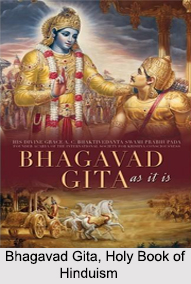
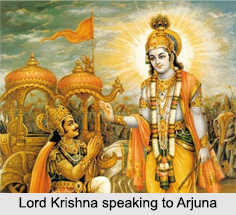
 Lord Krishna, Man and the essence of Karma Yoga forms the very base of the concepts of Bhagavad Gita.
Lord Krishna
According to the Bhagavad Gita, Lord Krishna is the `bijam mam sarvabhutdaam`, which means `Eternal seed of all beings`. He is described as the source, sustainer, and destroyer of the world, jagat. Lord Krishna is said to be the imperishable, aksara, and knower of the field, kshetragna or the beings in the world of everyday living. The Gita says that the Lord is the Perfect man, purusottama and pervades all things, supports all things and `same to all beings` in Sanskrit it is `samoham sarvabhutesu`.
The Bhagavad Gita refers the Lord Krishna as the father to the creation and resides in all souls which in Sanskrit are written like this `pita hum asya jagato`. He is said to be the ultimate goal of all living beings, who provides moksa to women, sudras and vaisyas. It is said that Lord Krishna praises those who see equally a cow, a brahmana, a dog and a dog-eater and don`t behave badly with them. Hence He is described as the goal, supporter, lord, witness, abode, refuge, friend, origin, dissolution, substratum, storehouse and immutable seed.
Man:
According to the Bhagavad Gita, man is a mere instrument, `nimitta-matra`. The theory of divine pre-destination has been affirmed here. The Gita has discussed about three gunas (qualities) that cause every man`s way of life. These gunas are
• Sattva (goodness): purity, reason, knowledge
• Rajas (passion): desire, active, restless
• Tamas (dullness): ignorance, laziness, reverse
These three qualities convey one`s existence and thought. These qualities remain in human nature like strings in a twisted rope. The attitude of a person is tempered by the dominant quality whenever one of them prevails over the other two. According to the Bhagavad Gita, the ideal man is the `sthitapragna` (Man of steadfast-wisdom). The man with self-control and who can withdraw his senses from the worldly objects is referred as the wise man, the `sthitaragfia`. This man is very disciplined and free from desire and pleasure, equally observes the gold and lump of the earth, neither rejoice nor laments, look for the welfare of all. This type of man neither hates nor desires, but remains neutral. He is never overflowed by any kind of desire, just as the sea does not overflow though all rivers flow into it. As per the Gita, this man with the `Sattva` quality holds everything equal and such a man is firm, fearless, self-restrained and dearer to God. The word courage is also associated with this type of man.
Niskama-Karma-Yoga:
The most important teaching given by the Gita is the concept of `niskama-karma-yoga`. This means to maintain one`s discipline of action without having any desire for the fruits and this thought was accepted unanimously. According to the Bhagavad Gita, yoga is the best by which man can unite with the God. The limitations of body cannot bind a man practicing regular yoga. One can also get relief from the ego, false through yoga. The Gita says that action with self-purification leads to nirvana. As per the Gita, rising above the normal state of life is the goal of man. The goal of a man is to become Brahman, brahmabhyam, and attaining God`s presence in one self. In short, it is the annihilation in Brahman, brahma nirvana. According to the Bhagavat Gita, the brahma nirvana can be attained by one with steadfast wisdom.