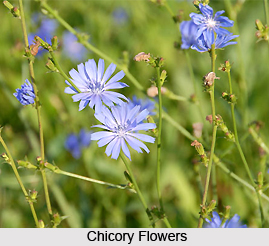
 Chicory is indigenous to the Mediterranean region or, probably, eastern India. It was popular among the ancient Greeks and Romans and was cultivated in Egypt over 2000 years ago. Ancient physicians used the plant in treating numerous severe ailments. Classical writers like Horace, Virgil, Ovid and Pliny referred to its use as a vegetable and a salad constituent. Some scholars were of the opinion that the name succory came from the Latin succurrene- meaning, `to run under`-because of its deep roots. Another suggestion is that succory may be an altered form of chicory, or cichorium, a word of Egyptian origin. Chicory has been cited as a special skin nourisher by ancient herbalists. A tea made from the pale blue flowers of this plant was believed to render shimmering skin.
Methods of usage
Chicory is valuable for diversified uses, like aiding in proper flow of urine and menstruation, aiding in organic malfunctions and optical defects.
Healing Power and Medicinal Properties of Chicory
Chicory is a revitalising herb when had in reasonable measures. It helps in increase of secretion and release of urine. It is also a stimulant and a gentle purgative. This herb helps in aiding functions of the liver and gall bladder.
Eye Defects cured by Chicory
Chicory consists of food components which are invariably needed by the optical system. It is one of the richest sources of vitamin A, exceptionally valuable for the eyes. The adding up of juices of carrot, celery and parsley to chicory juice makes it an exceedingly nutrifying food for the optic nerve and muscular system. It can bring about stupefying outcomes in rectifying eye defects. Half a litre to one litre daily of this mixture has time and again rectified eye defects within a few months, to the magnitude that normal vision was recovered, rendering the use of glasses pointless.
Constipation healed by chicory
The herb is an accepted purgative. It is, thus advantageous for the treatment of acute constipation.
Anaemia cured by chicory
The herb, in arrangement with celery and parsley, is incredibly facilitative for anaemia. It is an effective blood energiser.
Liver and Gall Bladder Dysfunctions healed by chicory
Chicory flowers, seeds and roots are medicinally used in treating liver malfunctions. Approximately 30 to 60 ml of decoction of the flowers, seeds or roots can be used thrice daily, with favourable results, in the treatment of torpidity or lethargy of the liver, biliary stasis or, blockage of bile, jaundice and expansion of the spleen. Endive or chicory juice, in nearly every recipe, encourages the secretion of bile and is, hence, excellent for both liver and gall bladder dysfunctions.
Respiratory Disorders healed by chicory
The amalgamated juices of chicory, carrot and celery are most useful for asthma and pollinosis, in condition that milk and foods containing condensed starches and sugars such as white rice, white flours, macaroni, sweets, pastries and cakes are rejected from the diet. Grind of the dry root in dosages of half a teaspoon, if taken thrice daily immixed with honey, is a good expectorant in acute bronchitis.
Obstructed Menstruation cured by chicory
A decoction of chicory seeds is valuable in treating hindered menstrual flow.
Other Uses of chicory
The young leaves, preferably livid, should be eaten in salads. They may be amalgamated with other greens to understate their strong flavour. The ripened green leaves are sometimes used as a cooked vegetable. The root, when roasted and mashed, is often used as a component to blend with coffee, or is taken as a beverage on its own.
Composition
Chicory, or endive, is a perpetual herb with an elongated tap root. It has compacted, round stems, several light or dark green leaves and pale blue flowers. The leaves are sour to taste; its flowers bloom at sunrise and wither at dusk.
An examination of chicory or endive leaves shows them to comprise 93.0% moisture, 1.7% protein, 0.1% fat, 0.9% fibre and 4.3% carbohydrate per 100 grams. Its mineral and vitamin contents include calcium, phosphorus, iron, carotene, thiamine, riboflavin, niacin and vitamin C. Its vital energy value is 20.
Chicory flowers contain a glucoside chichorin and sour substances, namely lactucin and intbin. Its seeds contain tasteless oil and the roots contain nitrate and sulphate of potash, mucilage and some bitter principle.