


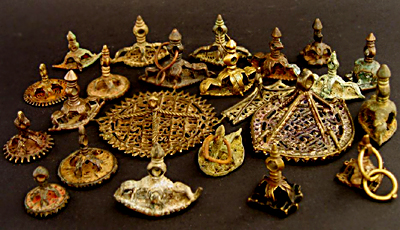
 Bronze ornaments are one of the most used ornaments in India. The South Indians used various ornaments that were directly shown in almost all castings and sculptures of Bronze images. These were nicely sculpted befitting the personality of the sculpture. Moreover, bronze has long been used in jewelleries like bangles, earrings etc. Bronze is ideal for casting art works; it flows into all crevices of a mold, thus perfectly reproducing every detail of the most delicately modeled jewellery pieces. Bronze jewellery was made in much the same way as Silver jewellery was, as the two metals have similar working properties. Bronze ornaments are one of the most used ornaments in India. The South Indians used various ornaments that were directly shown in almost all castings and sculptures of Bronze images. These were nicely sculpted befitting the personality of the sculpture. Moreover, bronze has long been used in jewelleries like bangles, earrings etc. Bronze is ideal for casting art works; it flows into all crevices of a mold, thus perfectly reproducing every detail of the most delicately modeled jewellery pieces. Bronze jewellery was made in much the same way as Silver jewellery was, as the two metals have similar working properties.
Some of the preferred bronze ornaments are Hara, Keyura, Udara bandha, Kucha bandha, Bhujanjja valaya, Kundala etc. Among these ornaments, Hara is a necklace, which is available in different patterns. Earlier, the hara used to be short in size and it formed a broad band made of several pieces. Later, it was styled according to the changes. Another ornament, Keyura is a flat ornament, which is worn on the arm just over the biceps muscle while Udara bandha is broad belt, which is worn at the junction of the thorax and the abdomen. Kati bandha is another type of belt, which is worn round the hip. A kind of jewellery named Kucha bandha is worn to support and keep in positions the breasts of the feminine figures. Including these ornaments, the jewelers of India create some other kinds of ornaments from bronze namely the Bhujanjja valaya which is one more type of ornament found in the bronze images. This ornament is worn in the wrist by Lord Siva. It is a bracelet and looks like a coiled snake. Kundala is an ornament of ear, which was also seen in the bronze images. Mainly the earring is referred as the Kundala. There are almost five types of Kundalas namely the patra-kundala, nakra kundala or makara kundala (leaf-like), sankhapatra kundala, lathakundala (creeper like) and sarpakundala (snake-like). The arm and the forearm ornaments were made by using Conch shells. The shell is cut cross-wise to produce a spiral ring and then it is thrust into the distended ear lobe. This type of kundala is called the sankha patra. The Ratna kundala is a jeweled circular earring. The makara kundala is the ear ornament, which is made in the form of the mythical makara, and the sarpa kundala is made in the form of a cobra. These ornaments found in the bronze images were mainly worn by Lord Vishnu and were known as the Srivatsa and Vaijayanti. The Srivatsa is a mark like a mole. It is conceived to adorn the chest of Vishnu in association with the kaustubhamani, which is a jewel. The Vaijayanti ornament is a necklace, which had groups of gems in a row. Each of them had fine gems in a particular order. The gems are pearl, ruby, emerald, bluestone and diamond. The udara bandha is an ornament worn by Lord Ganesha. It looks like a snake. Lord Shiva is shown wearing two types of ear ornaments in the bronze images. It indicates Parvati occupying his left half. The goddess Kali wears an ornament named ‘Preta kundala’ (ear ornament with a miniature dead body). The South Indian people were also shown wearing variety of anklets, rings on fingers and toes. Among all these ornaments, the crowns and hair ornaments indicate the status of the person wearing them. |
| |||



Home > Society > Indian Jewellery > Classification Of Jewellery In India > Bronze Ornaments in India
Bronze Ornaments in India
| Bronze ornaments, primarily found in South India, reflect the motifs found in the sculptures of this region. |
| ||||||||||||||||||||||||||||

