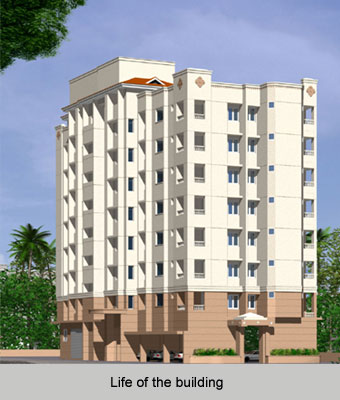
Life of the building, Vastu Shastra - Informative & researched article on Life of the building, Vastu Shastra
  Indianetzone: Largest Free Encyclopedia of India with thousand of articles Indian Religion


in  
Art & Culture | Entertainment | Health | Reference | Sports | Society | Travel
Forum  | RSS Feeds  | Free E-magazine
Indian Religion : Vastu Shastra l Indian Religions l Indian Myths l Indian Mythology l Gods of India l Goddesses Of India l Religious Thinkers of India l Types of Religion in India l History of Indian Religion l Indian Yogis l Ajivikas l Sacred Scriptures in Indian Religion l Tantra l Shaivism l Indian Communities l Sacred Animals in India l Roman Impact on South Indian Art and Society l Bhattacharyas l Indian Classical Terms
Home > Society > Indian Religion > Vastu Shastra > Life of the building
Life of the building, Vastu Shastra
Vastu Shastra provides exhaustive information about the life of a building.

Vastu Shastra provides exhaustive information about the life of a building for instance, what are the right ways to use a room and what should be the proper area of that room i.e. what should be the length and the breadth. As a result certain rules have been formulated.

The principles of Ayam are not applicable for buildings with a carpet area less than 2000 sq. ft. these will be only prove beneficial when applied to buildings with a carpet area of more than 2000 sq. ft. For flats and small buildings Ayam principles are, thus, not applicable. Such principles are referred as Vastu Chintamani, Muhurat Martanda or Samrangana Sutradhar.

To start with the area of the building needs to be by multiplying the length and the breadth. This area will again be multiplied by nine and the product will be divided by eight. The remainder is known as Ayam in Vastu Shastra. The Vedic science further divides the Ayam into 8 categories:

(1) Dhwajayam (2) Dhumayam (3) Simhayayam (4) Shwanayam (5) Vrishabhayam (6) Kharayam (7) Gajayam (8) Kakayam.

Dhwajayam: For this Ayam the formula to calculate the area is as follows-

If the remainder is one it is called Dhwajayam. This is an auspicious ayam. it will be more beneficial put this Ayam to use for constructing bathrooms. It is also useful for steel factories, cloth mills, sugar and rice mills. However if the remainder is Zero it will provide medium level benefits.

2) Dhumayam: When the remainder amounts to 2 it is known as Dhumayam. This would only be useful in building is kitchens in the south-east direction. According to Vastu Shastra Dhumayam is the harbinger of numerous troubles but primarily it adversely affects the health of the women in the house.

3) Simhayam: Here, too, the formula is the same. In all the Ayams the formula remains the same. What varies is the remainder. Depending on these remainders Vastu Shastra predicts the auspiciousness and the inauspiciousness of the houses.

In case the remainder is 3 it is known as Simhayam. This Ayam leads to the destruction of the enemy and victory of the self. Economic and physical happiness is also related with it. Therefore keeping in mind the measurements of Simhayam the bedroom of the head of the family should be constructed in the south direction. Courts, Parliament house, Goverment offices, industrial establishments, commercial complexes and hostels could be constructed by following this.

4) Shwanayam: If the remainder is 4 it is known as shwanayam. Shwanayam is the perfect Ayam only for lumber-room or storeroom. These should be constructed in the southwest direction. Shwanayam can give good results for hospitals, orthopedics, hardware store, libraries and others.

5) Vrishabhayam: In this Ayam the remainder will amount to 5. This is an auspicious ayam resulting in the accumulation of wealth. Dining room, bedroom, study room or meditation room should be constructed to the West of the residential building as per Vrishabhayam measurements. This would be quite useful for schools, colleges research centers, cotton mill, textile, sugar factories, receptions halls, auditoriums and others.

6) Kharayam: The formula to calculate this ayam is as follows:

If the remainder is 6 it is known as Kharayam. It results in making a man lethargic, even an addict. Hence it is inauspicious in the construction of residences. Garage, granary, godown or servants quarters can be built only in the northwest direction and at a distance of 2 to 3 feet from the wall compound.

7) Gajayam: This is considered auspicious as it leads to prosperity. The remainder in this kind of Ayam will be 7. With its measurements sitting room or strong room can be built in the north directions. it will prove fruitful for schools, lodgings, commercial establishments, cold storages and shops.

8) Kakayam: According to the last kind of Ayam only temples can be built with its measurements in the northeast directions. The remainder here will be 8.

(Last Updated on : 28/01/2009)
  More on Vastu Shastra...
 
Pyramid Vastu Home Vastu Vastu Principles
Essentials of Vastu Elements of Vastu Griha Pravesh
Designing a home using Vastu Vastu tips for a house Kitchen Room in Vastu Shastra
Bathrooms in Vastu Shastra Toilets in Vastu Shastra Sceptic Tank
Drainage Pipe Line Place of Idol and Worship Selection of Plot
Bedrooms Strong Room Verandah
Dining Room Drawing Room Store Room
Study Room Basement Corners of the Open Space around the Structure
Open Space Around The Building Parking Staircase
Upper Floor Central Position of a Flat in Vastu Overhead Water Tank
Proper and Improper Shape of the Plot Survey of the Land or Soil Waste Storage Rooms
Angles in the Corner of a Plot Compound Wall Engineering and Architecture in Vastu Shastra
L Type Plots Roads Around the Plot Auspicious Time for Bhoomipuja
Division of the Plot Gate of the Compound Wall Location of the Well
Plots with Circular Roads Vithishula Trees Around the Building
Entering a New House as per Vastu Shastra Purchase of the Adjacent Plot Building Material
Universal Magnetic field in the Plot Slope in a Plot Diagonal Plots
Life of the building Quality of a Plot Constructions of Religious Temples
Constructions of Factories Constructions of Shops Constructions of Hospitals
Construction of Banks Constructions of Educational Institutions Flat system in Vastu Shastra
Natural elements and the Vastu Division of a Diagonal Plot East-South-East Extended Plot
Flooring of the Flat North-North-West Extended Plot Rectifications in the Extended Plots
South-South-West Extended Plot West-South-West Extended Plot East-North-East Extended Plot
Entrance Gate for Main Building in Diagonal Plots North-North-East Extended Plot Purchase of the Adjacent plot along the Diagonal Building
South-South-East Extended Plot West-North-West Extended Plot Windows of Flat
Apartments and Flat Systems Bedroom in the Flat Kitchen in the Flat
Outhouse And Garage Main entrance Door of Flat Kitchen and Dining Table
Bathroom in flat Seating Room in the flat Structures in the Flat
Vastu in Different Units of a Flat Tips for Purchasing a Flat Row and Group Housing
Vastu Shastra Effect of Planets on Buildings Haunted Structures
Accursed Building Obstacle in a Structure or Dwarvedh Chhaya Vedh
Selection of the Right Plot Ways to Overcome Inauspicious Vithishula Trees Touching the Structure
Omens Related to Domestic Animals Omens Related to a Dog Omens Related to a Cat
Omens Related to a Horse Omens related to a Crow Junction Plots
Building Construction in L-Shaped Plots L and C Shaped Constructions Construction of L-type Buildings
Construction of C Shaped Buildings Buildings in Triangular Plots Omens Related to Birds
Omens Related to Serpent Omens Related to Sneeze Omens
Auspicious Constellations for Travel Multilevel Structures Structure On a Hill
Structure in a Ditch Vastu Shastra Related to Agriculture Interior Planning of the Main Building
Vastu Shastra for Buildings Semi - Diagonal or Extended Plot Units in Apartments and Flat Systems
Auspicious and Inauspicious Omens Mezzanine Floor  
Recently Updated Articles in Indian Religion
  • Dhammapada
    Dhammapada, the core of Buddhist teaching in Pali language, is considered the gospel of Buddhism even today
  •  
  • Brahma Nirvana
    Brahma Nirvana is the ultimate communion with the eternal Reality of life that is the Brahma.
  •  
  • Ahmadiyya Sect,
    Ahmadiyya Sect is an Islamic sect founded in India by Mirza Ghulam Ahmad of Qadian.
  •  
  • Arahant
    Arhant according to the philosophy of Dhammapada is an individual who has attained the highest degree.
  •  
E-mail this Article | Post a Comment
Free E-magazine
Subscribe to Free
E-Magazine on Indian Religion

 
Life of the building, Vastu Shastra - Informative & researched article on Life of the building, Vastu Shastra
Sitemap
Contact Us   |   RSS Feeds
Copyright © 2008 Jupiter Infomedia Pvt. Ltd. All rights reserved including the right to reproduce the contents in whole or in part in any form or medium without the express written permission of Jupiter Infomedia Pvt. Ltd.
