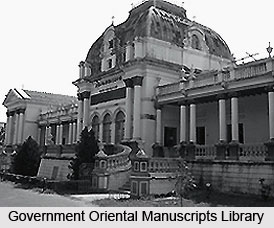
 The Government Oriental Manuscripts Library is one of the world`s largest and best manuscript libraries. It was established in 1867 in the western wing of the first floor of the Madras University.
It has mainly three important collections:
1.The Colonel Colin Mackenzie`s Collection (1754-1821)
2.East India House (Dr. Leyden)`s Collection (1803-1811) and
3.The C.P. Brown`s Collection (1798-1814)
The Col. Mackenzie`s precious Dravidian Collection consists of 1500 manuscripts. There are total 50,000 palm leaf manuscripts, 20,000 paper manuscripts and 20,000 books in the library. Most of the manuscripts are not decoded yet. It also contains the manuscripts of works in literature, history, philosophy and science, which are written in South Indian and Oriental languages as well as in Kaifiyats. The inscriptions found in many places belong to different periods.
Colonel Colin Mackenzie came to India in 1783 as a cadet of Engineers on the Madras Establishment of the East India Company. He was interested in the study of ancient mathematics, logarithm in particular and in Oriental languages. He had a collection of numerous manuscripts, coins, inscriptions, maps etc. These had information on the literature, religion, history, manners and customs of the people not only from different parts of India but also from Ceylon and Java. During his service as Surveyor-General of India in 1818, Colonel Mackenzie he brought all the precious collections with him to Calcutta and went on adding more to them till he died in 1821. The East India Company bought these collections from Mrs Mackenzie in 1821 for 10,000 pounds. They parted into three divisions of which one part was retained in London, the other parts were sent to Calcutta and Madras.
A collection of manuscripts in Tamil, Telugu and Kannada characters was noticed by C.P. Brown in the India Office Library, London. These were the collection of Dr. Leyden, who was a notable linguist and traveller. These were kept at the India House, London by East India Company, which bought them after his death. Later, CP Brown, who was in Indian Civil Service brought them to India. He gifted these valuable collections of paper manuscripts of Sanskrit and Telugu works to the East India Company and they brought them to India in 1855.
In 1869 a full blown library was set up. In 1870, the all the collections of were taken to the Presidency College. Mr Pickford, who was Professor of Sanskrit in Presidency College, was given the responsibility to prepare a catalogue for them. He was also directed to prepare a scheme for publication of important literary and historical manuscripts. He continued to collect and many other manuscripts by searching and purchasing them from various places of the country.
As the lingustic states are formed in the country, almost 7,000 manuscripts in Telugu, Kannada and Malayalam were transferred to Andhra Pradesh, Karnataka and Kerala respectively. Besides this, 22,887 printed books are available for reference in the Government Oriental Manuscripts library. It now consists of 71180 manuscripts in Telugu (2150), Sanskrit (48884), Tamil (16398), Kannada (250), Marathi (956), Urdu (184), Arabic (407), Persian (1390), other Oriental languages (127), and local records (434).
The Government Oriental Manuscripts Library has numerous rare and valuable palm-leaf manuscripts, which are very carefully preserved by manual and chemical methods. The damaged paper manuscripts are repaired with chiffon cloth and preserved carefully. The Oriental Manuscripts Library publishes multilingual bulletin annually, which consists of rare and unpublished manuscripts in various languages. Till today, total 21 volumes of this bulletin have been published. The library has published total 350 publications till now, which includes descriptive and triennial catalogues of its manuscripts in various languages.
These are published under two categories named- the Government Oriental manuscripts series and Government Oriental series.
The Government Oriental Manuscripts Library is a government institution headed by the Curator under the control of the Director of Archaeology, Government of Tamil Nadu.