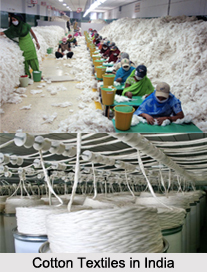
 Cotton is the most famed material in the Textile Industry in India and the Cotton Textiles are considered amongst the oldest industries in India. India is one of the important cotton-manufacturing countries of the world. Both short-staple and long-staple cotton is grown in the country. There are several worth mentioning features of the cotton textile industry in India. It is based on indigenous raw materials.
During 2008-2009, the cotton textile industry had suffered unfavourable climatic conditions that hampered cultivation; yet, it managed to generate 290 lakh bales of cotton, and still retained the 2nd position in world cotton production.
History of Cotton Textile Industry in India
In the early 18th century, the export of cotton textiles to the European countries revolutionised the Textile Industry and Agriculture in India. Cotton textiles can be traced back to the times of Indus Valley Civilization, when cotton fabrics of India were in great demand even in the countries of Europe and West Asia. It used to be a cottage or village industry during those times.
The modern textile industry in India first began at Fort Gloster near Kolkata in early 19th century. But it in reality made a head start in Mumbai in the year 1854 when a cotton textile mill was set up there exclusively out of Indian funds.
Growth of Cotton Textile Industries in India
It is India"s one of the most traditional and esteemed industries. Research shows that in between 1995 and 1996, this textile industry provided employment to over 64 million persons, next only to agriculture. Cotton textile industry in India has all along prospered on its own funds. On the other hand, the country possesses the most contemporary capital intensive and high speed mill-produced cloth with a huge market both at home as well as abroad. Further, in 1997 and 1998 the country had produced 37.4 billion metres of fabrics.
The fabrics are basically produced in 3 sectors - Mills, Powerlooms and Handlooms. Together they account for around 98.5 percent of the fabrics produced in the country. The Mill sector accounts for only 5.2 percent of the total fabrics produced in the country, whereas Powerlooms and Handlooms are responsible for nearly 73 percent and 20.3 percent respectively. For example, the whole sari sector is earmarked for handloom and powerloom sectors. The latter also produces hosiery on a vast scale, by and large for export purposes. India also exports quality yarn to Japan and other European economic communities.
Lately, the readymade cotton garments industry has been developing in tremendous momentum to cater to foreign markets. They are thus bringing home prized foreign exchange. One of the problems faced by cotton textile industry in India was the old-fashioned technology of old mills and their industrial sickness. Slowly, but steadily old technology is being taken over by the new one. The cotton textile industry has implemented numerous techniques and measures to supply eco-friendly products, which are of superior quality, to the world market. In India, use of non-hazardous colours and dyes has come into use for manufacturing textiles.
Cotton Textiles Productions in India
In India, cotton textiles production is basically located in Maharashtra, Tamil Nadu and provinces of Gujarat. Interestingly, several government programmes have sustained cotton textile industries in almost all the states in the country. In the country, because of irrigation restrictions, cotton textile productions are heavily dependent on monsoon season. Now the proportion between natural and human-made fibre is almost equal. The important centres of cotton textiles industry comprise Mumbai, Ahmedabad, Coimbatore, Madurai, Indore, Nagpur, Solapur, Kolkata, Kanpur, Delhi and Hyderabad.