


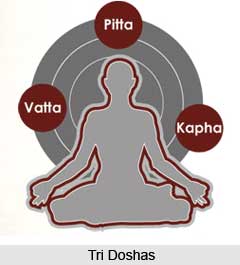
 According to the beliefs there are three elements in the body, which cause diseases. These can be said as vata, pitta, and kapha. They hold the pride of place among the body constituents. It would be relevant here to point out that the doshas are not defects as some translators of Ayurvedic texts have erroneously assumed. According to the beliefs there are three elements in the body, which cause diseases. These can be said as vata, pitta, and kapha. They hold the pride of place among the body constituents. It would be relevant here to point out that the doshas are not defects as some translators of Ayurvedic texts have erroneously assumed.
Vata: All the human beings are made up of space and air, with some light, water, and earth thrown in. Vata helps to transmit perceptions to the mind and body and maintains the body's natural balance. The energy, which is used to transmit the outside world to our inner selves when become imbalanced then diseases, sets in. Pitta: This is the energy, which is responsible for vision, digestion, heat, hunger, thirst, happiness and intelligence. When this element gets imbalanced it results in apathy, depression, dehydration, digestive problems, and weight gain or loss. Kapha: It is the disease, which is due to the lack of conserving and stabilizing the body. Commonly they are called as viruses or bugs. Vyaadhi is usually known as disease. It is the state of the being when the person is full of discomfort or pain. All these are caused by an imbalance in one of the three elements. These diseases are treated according to the classification of trauma. When any of the three doshas becomes excessively agitated or increases disproportionately in relation to the others, an imbalance is created, and thus disease results. The loss of dynamic equilibrium may be due to the excessive or deficient use of the five sense organs. These sense organs can be named as the ears, skin, eyes, tongue, and nose. They regulate the action of body, mind, or speech and also time, that is, the different seasons. The restoration of health would then depend on regaining the balance among the three doshas. That balance depends on the consumption of environmental matter in the right form, proportion, combination, and at the right time. When the physician becomes sure of the nature of the imbalance of the doshas, he prescribes a substance, namely, a drug or a diet, which will correct the disequilibria. Everything in nature has relevance for medicine and that is why Ayurveda has collected a fund of data on the therapeutic effect of all kinds of natural substances. Seasons, plants, natural substances, and constituents of the body are all integrated into a complex theory of physical health as equilibrium of somatic and environmental elements. The theory of tridoshas has led the ancient teachers to make a classification of human constitutions or deha-prakritis. The predominance of one dosha determines the constitution that a person has. If there is an excess of vata, it results in a person having a vatala constitution. And in the same way the predominance of the other two doshas gives rise to pittala or shleshmala dehaprakriti. The other four constitutions depend on the nullification of more than one dosha. The deha-prakritis are pre-determined body constitutions that a person is born with. And there is as such no change in their basic structure till one dies. Each type of body constitution or deha-prakriti has some peculiar dietary and other habits, and a predictable response to drugs. It is one of the cardinal rules of Ayurveda that medicine cannot be prescribed for a patient unless the physician has checked the patient. The physician should diagnose the patient first. A drug that helps one type of constitution will not help a different deha-prakriti. It is imperative to understand that in Ayurveda, the true drug is the one, which cures a patient without producing any side effects. Ayurveda maintains that illness results from the disturbance of the equilibrium among the three doshas and other body constituents, and any loss of that balance in an individual makes him or her susceptible to manifold disorders. |
| |||



Theory of the Tridoshas
| The theory of the tridoshas in ayurveda revolves around the three elements of body viz Vata, Pitta and Kapha. |
| ||||||||||||||||||||||||||||

