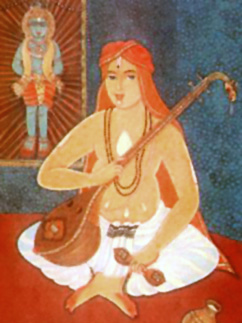
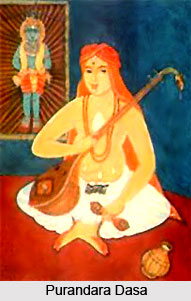
 Purandara Dasa is the founding father of present day `Carnatic music`. He is also given the title of the `Sangita Pitamaha`. According to inscriptions, he was born in 1484 AD at Kshemapura near Tirthahalli in Shivamogga district of the state Karnataka. Some scholars believe that he was born in Purandargarh near Pune, which is considered as a historical mistake. He belonged to a rich Naik family and his birth name was `Srinivasa`. His father`s name was Vara-dappa Naik, a rich merchant. Following his father`s legacy, Purandara Dasa became an extremely well to do village banker. But, before this, he completed education in accordance with the family traditions and acquired proficiency in Kannada, Sanskrit, sacred lore, and in music.
Personal Life of Purandara Dasa
Purandara Dasa got married to Saraswathi Bai at a very young age and became the father of four sons. His wife was a pious and God fearing lady. He lost his parents at the age of 20 years. He never respected the virtues of his wife. It is said that, when he was at the zenith of his business, an incident related to the `nose ring` of his wife changed his life and his thoughts. Thus, he realised the worthlessness of his attachment to worldly possessions. The story is like that, one day a Brahmin man came to Purandara Dasa`s wife to lend some money to perform the sacred thread ceremony of his son. She offered him the nose ring of her, as she did not have cash. The Brahmin unfortunately went to Purandara to sell the nose ring to get the money. He gave money to the man and took the ring. On the other side, the worried wife started to pray her favourite deity to save her from the rage of her husband. The deity provided her a nose-ring just like the one she had. Back home, Purandara Dasa was astonished to see her wearing the same ring. As his wife explained him what happened, he was transformed in the virtue of his wife and the virtue of a charitable life. He then donated all his wealth to charity and left home with his family to lead the life of a wandering minstrel to spread the gospel of God. He went to Vijayanagar Empire and took the spiritual guidance of Vyasaraya, where he got the name Purandara Vittala. He began the `Dasa Kuta` or assembly of `dasas` or slaves of the Lord. And he renamed himself as the `Purandara Dasa` from Srinivasa.
Life in Music for Purandara Dasa
At that time, the age of Purandara was only 30 years but his feeling of regret was quite visible in his very first song. He was asking apology in that song for wasting his life in indulgence till today. It was set in `Triputa tala` and begins as `Ana lae Kara` in Suddha Savaeri raga. He had the habit of concluding his songs with a salute to Lord Purandara Vittala. He composed almost 475,000 songs but among them only about 1000 is known at present. And this can be proved from his song `Vasudeva NamaraUya` in which he cited about this fact. The compositions of Purandara Dasa were popular as `padas` and `devarnamas`. His keertanas are generally in `Adi tala` and `Madhyama tala`. He composed all his music in Kannada Language and Sanskrit Language. He had very good understanding of the music and his compositions also appealed to the illiterate common folk. He used to propagate the virtues of Bhakti Movement or devotion through his simple songs. The signature of Purandara Dasa in his composition was Purandara Vittala.
Purandara Dasa codified the beginners` lessons in Carnatic music. For the students, he took up the raga `Mayamalavagaula` for the first lessons and also divided the lessons into `Sarali` and `Jhanta rarisais`, `Alankarams and `Agitams`. And these rules are followed even today without any change.
The references of the holy places such as Kasi, Udupi and Tirumala shows that he had travelled all over and also met Tallapaka Annamacharya at Tirumala. He spent the last part of his life in Hampi. There is a `Mandapa` named `Purandaradasa Mandapa`, where he stayed. He became a sanyasi at the close of his life and died in 1564 AD. Just after his death, the battle of Talikota took place and Dasas got scattered here and there. As a result, the songs of Purandara Dasa also got scattered and most of them got vanished. The late 19th century and the early 20th century musicians tried to revive the songs of Purandara Dasa but they lacked the knowledge about the original ragas used by the composer himself. So, they set his songs to various modern tunes.
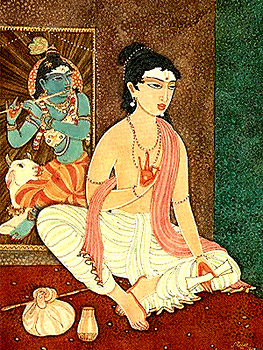
Purandara Dasa
He was regarded as the founding father of present day `Carnatic music` also called the `Sangita Pitamaha`.