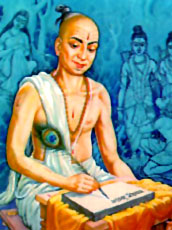
Mallinatha was a great scholar and a poet of 14th century. He lived at Warangal in Andhra Pradesh. Mallinatha was the son of Kapardi and belonged to the Kolacala family and his gotra was Kashyapa. He was very much pampered at young age as he belonged to a very rich family. He used to be very lazy during childhood and left his studies at an early age although he got trained under proficient teachers.
Mallinatha was regarded as one of the greatest commentators and an all round scholar well versed in different branches of learning. He has written commentaries on the five great poems or Mahakavyas such as `Raghuvamsa`, `Kutnarasambhava`, `Naishada`, `Kiraturjuniya` and `Sisupalavada`. He has also written the lyric of `Megbasandesa`. These are all are regarded as priceless treasures throughout the world. He was a very creative writer and a poet of high order and it is proved through the prayers in the beginning of his commentaries. Mallinatha had a good hold on the Dharma Sastra. He also wrote `Vaishyavamsa sudharnava` on judicial doctrines.
Mallinatha was very handsome when he was young. Moreover, being from a rich family made him the most eligible and was in high demand as son-in-law. Later, he tied the knot with a very learned lady. After his marriage, the wife found him very unsuitable and ignorant compared to her. While on a visit together, Mallinatha praised the beauty of a flower lying on the roadside. On this, his wife commented, "Of what use is its beauty? Since it does not possess fragrance, it cannot be used for worship". These words of his wife struck in his mind and he decided to get his education completed. He entered in a `Guru Kula` but for a married youth like him, who never worked hard, the life in `Guru Kula` became very tough. But Mallinatha did not stop and concentrated in his studies.
On the advice of her husband, the gurupatni served neem oil instead of ghee, with his meals. But he was so much absorbed in his studies that he could not make out any difference. For this hard work, he progressed very fast in his studies. But one day, at the end of the meal he said to the gurupatni, "Mother, the food is bitter today". Then the guru sitting next to him patted on his back with a smile and asked him to go home, as his education is complete now. Then the guru told informed him that he was taking meal with neem oil throughout his education period in guru Kula.
Back home, Mallinatha wrote commentaries on Kalidasa`s works, which were regarded as very high quality works. Now, his wife asked him to write a poem on her, as he had become very learned person. After forcing a lot, he wrote a poem describing her like `Shoorpanakha`, which irritated her and she kept waiting to get back at her husband. While writing the commentaries, Mallinatha used to write "ityarthah" i, e `this is the meaning` and "iti bhavah" i, e, `this is the import`. Even during normal conversation, he used these words sometimes. So, one day when Mallinatha asked his wife what would be served for lunch, she replied in Sanskrit, "There is boiled ityartha, majjigehuli called iti bhava. Have this lunch and be satisfied". Thus, Mallinatha became proud of his wife for her knowledge.