


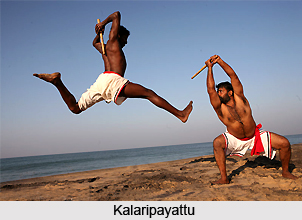
 Kalaripayattu is an ancient form of martial art training and discipline of Kerala. It is regarded as the only form of the most ancient traditional systems of physical, culture, self-defence and martial art technique still existing in India. It is the forerunner of all martial arts and it is still practiced and taught in Kerala. Kalaripayattu has its root back to the 12th century AD when the conflicts between the feudal principalities in the region were very common.
The term Kalaripayattu means 'combat training inside the gymnasium'. The word 'kalarihas' is derived from the Sanskrit word 'kholoorika', which means 'a military training ground'. The art is taught in a special ground called a 'kalari'. The charge of the Kalari is taken by the 'Nayakanmar'. The Nayakanmar then becomes 'Nayar' in some regions, like 'Kurup', 'Nambiar', 'Panikar' etc. The Nayar, who has the charge of a particular Kalari or group of Kalaris are called 'Gurukkal'. The Kalari is partly a gymnasium, partly school and partly regarded as a temple. It is constructed by following the traditional ethics. History of Kalaripayattu The effort made by Kerala to mobilise itself against the Chola threat transformed the entire country into a military training camp. It had been often suggested that is was possibly during this time that the Kalari system evolved. Training in Kalaripayattu The kalari is designed in rectangular shape and is aligned in east west and Hindu deities are placed in each corner. The Kalaris are established in almost all the homes of the Nairs to teach the methods of welfare. The training of Kalaripayattu starts at a very young age. Both the boys and girls come to learn the art. The learning of the art of Kalaripayattu involves the ritual stretching and flexing exercises. It is supposed to help in achieving concentration and balance. To increase the agility of limbs, a full body massage is also done. Various new weapons are introduced as the trainee or the student develops to learn the new techniques. These weapons include the sword and shield of the medieval warrior. During the training period of Kalaripayattu art, if a trainee gets injured then treatment is done based on the Ayurvedic principles. Thus, with the development of this art, a traditional system of medical treatment for bone and soft tissue injuries also evolved. At the time of the learning period, the trainees are offered regular physical exercises and trained with weapons like spear, dagger, sword and shield etc. The most brilliant students are taught the marmas like the vulnerable points in the human system. In some parts of Thiruvananthapuram and Kozhikode, the art of Kalarippayattu can be seen and learnt. The training of Kalaripayattu is targeted to the ultimate coordination of mind and body. Types of Kalaris The Kalaris were of two types initially. The smaller one was known as 'CheruKalari' (cheru means small) or Kuzhi Kalari (kuzhi means the portions formed by caving in the earth). The second type was 'Anka Kalari.' The Kuzhi Kalari type is named so because the floor of this particular Kalari was built at a lower level than the surrounding land by taking out soil to attain the necessary depth. This type of Kalari was built to provide physical and weapon training. The systematic and scientific ways of exercise in Kalarippayattu was first imparted in the Kuzhi Kalari type of Kalari. The purpose of building the 'Anka Kalari' was to fight duels to decide any quarrel between the local rulers or for a cause of revenge or for some other reason. For this type, the Kalaris were made in a place, which can accommodate all the people of local region so that they can watch the duel properly. Another type of platform named, 'Ankathattu' was also used for fighting duels and it belongs to the same class as 'AnkaKalari'. The platforms were constructed four to six feet above the ground level for which famous carpenters were engaged. The platforms were built before the date fixed for the duel. To start with this, first elaborate rituals are performed and then the 'Ankathattu' would be handed over to the fighters. Thus, to practice Kalaripayattu one has to develop acrobatic capabilities, when using swords or knives to attack their adversaries and even an unarmed exponent. |
| |||



Kalaripayattu Martial Art
| Kalaripayattu is an ancient form of martial art training and discipline of Kerala, which has its root back to the 12th century. |
| ||||||||||||||||||||||||||||

