 Jainism in India has a history of more than 5000 years. It enjoyed royal patronage and has produced worthy monks and laymen of whom any society could be proud. The Jain contributions to Indian architecture and art, to the preservation and enrichment of Indian literature, and to the cultivation of languages, both Aryans and Dravidians, are praiseworthy. The religious instincts inculcated by Jainism have left an abiding impression on many aspects of Indian life.
Derivation in Jainism
The name Jainism derives from the Sanskrit verb ji, "to conquer." It refers to the ascetic battle that, it is believed, Jain monks and nuns must fight against the passions and bodily senses to gain omniscience and purity of soul or enlightenment. The most illustrious of those few individuals who have achieved enlightenment are called Jina (literally, "Conqueror"), and the tradition"s monastic and lay adherents are called Jain ("Follower of the Conquerors"), or Jaina. This term Jain came to replace a more ancient designation, Nirgrantha ("Bondless"), originally applied to renunciants only.
Rise of Jainism in India
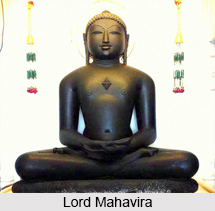
According to Jainism twenty-four Tirthankaras have flourished in this age. The first leader was Rishabha, the twenty-second Nemi or Neminatha, the twenty-third Parshvanatha, and the last, Lord Mahavira. Rishabha figures as a great saint of ancient times and is said to have laid the foundations for orderly human society. Neminatha is associated in Jainism with Lord Krishna of theYadava community. These and other Tirthankaras are prehistoric in character. The age Mahavira lived in was marked by great philosophical speculation, in which a number of eminent teachers participated.
 Influence of Jainism
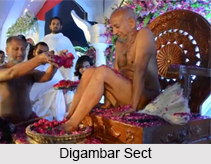
The Jain Church has shown quite a modest yet steady progress. The influence of Jainism gradually spread to the western India. Under the leadership of Bhadrabahu, many monks went to the south owing to the famine in the north. The differences in ascetic practices led to a split in the Church, dividing it into its two main sections, the Digambara Sect and the Swetambara sect. The basic religious principles remained the same for both, but they differed among themselves on minor dogmas, mythological details, and ascetic practices.
Principles of Jainism
Jainism starts with two principles, the living (jiva) and the non-living (ajiva). The living is already in contact with the non-living from beginning. This contact subjects the living being, on account of thoughts, words, and acts, to the influx of fresh energies known as karmas, which are conceived as subtle matter. This can be counteracted by religious discipline; and the existing stock of karmas can be exhausted through severe austerities. Then salvation is attained. The soul with its consciousness is permanent even when it is changing through various bodies in different births. All inanimate objects have consciousness because they are endowed with soul. They can feel hurt by bad treatment. For this reason ahimsa was carried to an extreme degree by him. The apprehension of an ordinary human being is partial, and therefore valid only from a particular point of view. This is called `nayavada` in Jainism. There are seven points of view or `nayas`.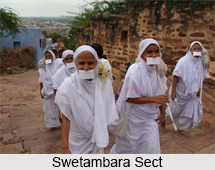
A thing or an object of knowledge is of infinite characteristics which require analyzing and apprehending individually, and this function is fulfilled by the nayas. This doctrine of Jainism serves as a unique instrument of analysis. Jainism admits no God to bestow favour.
Karma in Jain philosophy
Karma in Jain philosophy plays a very important role in shaping a man`s life. Jainism lays special stress on the ethical code. This takes two forms, one intended for the householder and the other for the monk. Practices such as these have maintained a close tie between the layman and the monk; both are actuated by the same motive and moved by the same religious ideals, with the result that this close association between them has contributed remarkably to the religious solidarity of the Jain community.
Art of Living in Jainism
According to Jainism, dying is as much an art as living. A layman is expected not only to live a disciplined life but also to die bravely a detached death. There are elaborate rules about voluntary death which has been practiced not only by Jain monks but also by pious laymen. The five anuvratas of a layman are supposed to be observed with maximum rigor and thoroughness. These sins lead to the influx of karmas.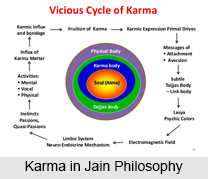
Theory of Anekanatavada
Another important contribution of Jainism is the theory of Anekanatavada, which says that the universe is independent to the mind or consciousness. There is no place in Jainism for God as a creator and distributor of prizes and punishments. By God Jainism understands a liberated soul. The Jain Tirthankaras, who provide the highest spiritual ideals to which every soul can aspire.
Iconography of Jainism
The worship of idols in a refined form, the building of temples, the founding of charitable lodges for men and animals, the preservation of rich libraries of manuscripts, and the distribution of food and other necessities to the poor are features of Jain society.
Social Division in Jainism
The equality has been emphasized in Jainism. They were against caste system on the basis of birth but later they accepted it on account of their close contact with the Hindus. The great message of Jainism is that an individual must become a man before he can think of heaven.