Symptoms of the Kidney Disorders
|
Symptoms of Kidney Disorders is usually silent. Chronic kidney disease can affect almost every part of a human body.
|
|
|
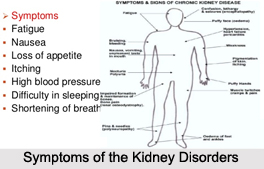 Symptoms of Kidney Disorders develop over time if kidney damage progresses slowly. Signs and symptoms of kidney disease are often nonspecific which means they can also be caused by other illnesses. Because the kidneys are highly adaptable and able to compensate for lost function, symptoms may not appear until irreversible damage has occurred. Symptoms of Kidney Disorders develop over time if kidney damage progresses slowly. Signs and symptoms of kidney disease are often nonspecific which means they can also be caused by other illnesses. Because the kidneys are highly adaptable and able to compensate for lost function, symptoms may not appear until irreversible damage has occurred.
Signs and symptoms of kidney disease may include:
Pain in the back or sides is a common indicator of kidney disease but is not seen in everyone who suffers from the condition. The pain is characteristic and you may feel a severe cramping pain that spreads from the lower back into the groin. This symptom could be an indicator of many conditions like Kidney stone, polycystic kidney or a chronic inflammation of the bladder wall.
Changes in urinary function are the first symptom of kidney disease. Increase or decrease in amount of urine pass, dark coloured urine, feeling the urge to urinate but unable to do so and increase or decrease in frequency, especially at night.
Difficulty or pain while urinating could indicate a urinary tract infection responsible for pain or burning during urination. If the infection spreads to the kidneys, it might cause fever and pain in the back too.
Blood in the urine is a symptom of kidney disease which is a definite cause for concern.
Foamy urine is caused due to the leakage of protein from the person’s body and is another symptom of kidney disease.
The build-up of waste products in the blood in kidney disease can also cause nausea and vomiting.
One suffers from loss of appetite due to the build up of toxins and waste materials in the body.
Sleep problems.
Anaemia associated with kidney disease also depletes the brain of oxygen which may cause dizziness, trouble with concentration, etc.
Muscle twitches and cramps.
Swelling of feet and ankles.
Skin rashes and itching is a symptom that is commonly confused with other more harmless conditions like an allergy, but rashes could also indicate kidney disease and failure.
Shortness of breath, if fluid builds up in the lungs.
High blood pressure which is difficult to control.
It usually gets recognized at an extremely late stage. Not many people are aware that the symptoms of kidney disease are not silent. Therefore, it is essential for one to recognize the symptoms of kidney diseases early so that one can seek treatment for the same.
|
|
|
|





