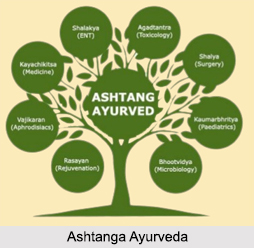
Ayurveda is the "Science of Life and Longevity". Practised since the pre-Vedic period, Ayurveda in India is indeed one of the well recognised traditional systems of medicine emphasizing the divine use of mind, body and the spirit in the prevention and curing of ailments. Quite ideally therefore Ayurveda as a holistic treatment procedure maintains a definite relationship between the metaphysical state and the illness of an individual. There are eight branches of Ayurveda known as the "Asthanga Ayurveda". With support of these eight branches, Ayurveda promises a healthy living during the entire life span whilst combining the body, mind and spirit with that metaphysical cord of "ayus"(life) and "veda"(knowledge).
Precisely, the eight branches of Ayurveda or Asthanga Ayurveda deals with the measures that are considered as the required elements for living a healthy life whilst striking the balance and harmony within human existence. The eight branches of Ayurveda treat internal and external ailments in every possible way as well as maintain a healthy body throughout life.
The eight branches of Ayurveda have been categorised as:
1. Kayachikitsa i.e. general medicine;
2. Shalya Tantra i.e. major surgery;
3. Shalakya Tantra i.e. ear, nose, throat, eye, and mouth related diseases;
4. Bhuta Vidya i.e. psychiatry;
5. Bala Tantra i.e. obstetrics, Gynaecology, and paediatrics;
6. Agada Tantra i.e. toxicology;
7. Rasayana Tantra i.e. rejuvenation; and
8. Vajikarana Tantra i.e. aphrodisiacs with their sheer science and mysticism strikes the balance from abstract transcendental values to concrete physiological expressions.
Kayachikitsa: The first branch of Ayurveda, Kayachikitsa targets the entire body and not just the ailing portion. This branch of treatment incorporates change in food habits, change in clothing, change in housing to suit the seasonal cycles and an overall change in lifestyle.
Shalya Tantra: The surgical methods, which were initiated by the Ayurvedic sages in ancient India, are collectively known by the name of Shalya Tantra and are indeed one of the important branches of the Asthanga Ayurveda. The word literally signifies the elimination of irritating factors from the human body.
Shalakya Tantra: Shalakya Tantra deals with the treatment of diseases located above the neck. This branch amongst the Asthanga Ayurveda is concerned with the causes, diagnosis, prophylactic measures and the curative procedures of the diseases of the head, ear, nose, eye and throat. Different methods are available for the treatment of these problems. The treatment is mainly done by using Shalaka, which means a rod or a probe, a technique which has given Shalakya Tantra its name.
Agada Tantra: Another important branch of Ayurveda is named as Agada Tantra. This offers detailed information about the non- animal and animal poisons and the methods of elimination of these poisons from the human body. It particularly advocates different antidotes for materials which are poisonous to the human body.
Rasayana Tantra: Rasayana Tantra is that essential branch of Ayurvedic science which deals with various preventive measures for ensuring a hale and hearty existence. It is a kind of rejuvenating therapy, which rejuvenates the healthy person and restores a diseased person to health. Rasayana Tantra aims at longevity, enhanced memory, health, youthfulness and radiance of complexion, generosity, bodily vigour and the sharpness of the senses.
Vajikarana Tantra: Vajikarana Tantra deals with various diseases like infertility and weakness of the Shukra Dhatu or the vital reproductive fluids of the body.
Asthanga Ayurveda or the eight branches of Ayurveda thus highlight individual uniqueness in relation to natural habitat; quite ideally therefore the emphasis is not on cure alone but also on preventive healthcare.