Arunagirinathar was a great poet, who was born in Tiruvannamalai, a town in Tamil Nadu during the reign of Praudha Devaraya II of the Sangama Dynasty of Vijayanagar (1422-1446). He was born to a courtesan mother called Muttamai. This family background made him to lead a life full of sin and corruption. Lord Muruga was the family God of his ancestors. Soon after his birth his father died and his mother and sister brought him up in the rich cultural and religious traditions.
Arunagirinathar`s father expired soon after his birth and his mother and sister brought him up in the rich cultural and religious traditions. During the days of his youth Arunagirinathar was attracted to pleasures and luxuries of life and he could do anything for getting his pleasures. Legend says that once he wanted money from his sister for pleasure but his sister had no money to provide him. At this Arunagirinathar`s sister said that he could sell his sister in order to get money. Hearing this, young Arunagirinathar felt ashamed and resorted to a temple. He asked forgiveness from Lord Muruga. The Lord forgave him and instantly transformed him to a saint. He was initiated him into the `Sbadakshari mantra` a six-syllabled mantra of Lord Muruga. He also helped him with the first words of a song starting with `Muttaitarnpattitiritnqgra. Thus a poet was born within him, which started a new era in Tamil poetry.
Arunagirinathar then acquired the vast and deep knowledge of religious and spiritual literature. He made brilliant expression and learning in the Tamil language. In fact Arunagirinathar is known as a profound composer in Tamil language. The works of Arunagirinathar have heavily drawn from certain Tamil works such as Tevaram, Tirukkural, Kaarigai, Ula, Easal, Kalambakam, Kovai, Sindu, Madal and Maalai. He used to write the eulogy of wealthy people to gain gift of money from them. He used many Sanskrit terms in his compositions and the writings reflect his knowledge about the Itihasas, Puranas, the Bhagavad Gita, the Upanishads, Agamas, Mantra-Tantra Sastras, Yoga Sutras and Kama Sutra. This also proves his command over the language of Sanskrit along with Tamil. The two songs of Arunagirinathar, which he dedicated to Lord Muruga, were written mostly in Sanskrit.
There is another belief about his inclination towards Lord Muruga from his cursed life of luxury. It is said that once a Mahatma had spoken to Arunagirinathar compassionately. He had advised him to meditate on the six-faced God Shanmukha but he did not care those words. Then, people started to disregard him for ignoring the advice of the Mahatma. After this incident Arunagirinathar decided that he would spend some part of his time meditating upon Lord Muruga which was installed in the Gopuram. But his wicked and immoral life did not allow him to persist in that attempt. Then he surrendered at the feet of Lord Muruga and tried to suicide.
Arunagirinathar was familiar with the tala system then prevalent. In a section of the Tiruppugazh called the Bhoota Vetala Vaguppu he mentions the name of five Margi talas namely, Chachatputa, Chachaputa and so on. The Tamil names of the seven swaras, gamakas, raga names, different musical instruments and even references to dance are also found in the Tiruppugazh.
Arunagirinathar brilliantly handled the four varieties of poetry known as Ash, Madlmra, Clritra and Vistara. The subject matter of the Tiruppugazh includes many episodes from the Ramayana, Mahabharata, Puranas, Sura Samharam and Tripura Dahanam. The Tamilians, who used to feel very proud of their poet, honoured him with several titles such as Muttamizh Arasar, Chandappavala Peruman, Thala Chelvar, Vakkirku Arunagiri and many more.
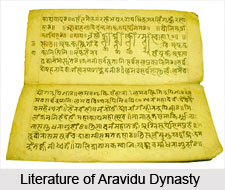
Arunagirinathar had also visited all the temples of South India and composed over 60000 songs of which only about 1330 can be found today. The life of virtue and righteousness are reflected from his songs and they set the tone for a new form of worship, the musical worship. The Thiruppugazh songs composed by Arunagirinathar remained in the manuscripts for a long period of time and as a result were left ignored and forgotten in this way until V T Subramania Pillai and his son V S Chengalvaraya Pillai of Tiruthani understood their value and retrieved them. Later, they published all these compositions and brought before the common people.