Tyeb Mehta, Indian Painter - Informative & researched article on Tyeb Mehta, Indian Painter
 Indianetzone: Largest Free Encyclopedia of India with thousand of articlesIndian Paintings


in  
 Art & Culture|Entertainment|Health|Reference|Sports|Society|Travel
Forum  | Free E-magazine  | RSS Feeds  
Indian Paintings : Indian Painting |Painters of India |Types of Indian Painting |Indian Folk Painting |Traditional Indian Painting |Famous Indian Paintings |Deccani School of Painting |Indian Oil Painting |Paintings in South India |Paitkar Painting
Home > Art & Culture > Indian Paintings > Painters of India > Tyeb Mehta
Tyeb Mehta, Indian Painter
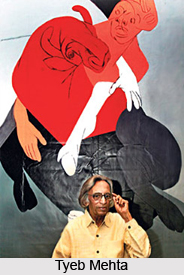
Tyeb Mehta’s paintings are the result of his engrossment in the formalist way of expression. He possesses the honour to have received the highest ever price for an Indian painting, painted by him.

 Tyeb Mehta, Indian painterTyeb Mehta was born in 1925, in Gujarat, India. He started his career as a film director. Later his passion for arts led him to Sir J.J. School of Art, Mumbai, from where he completed his graduation in 1952. After that, he left for London and Paris for four months. On his return to India, he conducted his first solo exhibition of drawings, paintings and sculptures in 1959 at the Jehangir Art Gallery, Bombay. He lived and worked in London from 1959 to 1964. Afterwards he visited US in 1968 on a Rockefeller Fund Scholarship. He was a multifaceted persona.

Mehta resembles other artists of the Progressive Artists Movement in India. He traces back his work to the European masters. His works were inspired from the macabre deformation used by artists like Francis Bacon. He learnt pictorial language of European art during the 1950s and `60s and after coming back to India, he attempted to blend the fundamentals of that art form with the `Indian` themes and subjects throughout the `70s and `80s. Mehta had nailed down his search for the eternal in the composite, from painting rickshaw-wallahs to a tied up bull, to layered images and conceptions of Hindu mythology. The 90s experienced his imagination in the form of myth of the Goddess - as Durga, Kali, Mahishasura Mardini and different incarnations of the goddess.

While creating multiple images he uses the ancient Indian technique in order to convey motion. This is seen in cases of the Nataraja who has many arms. The arm interprets the movement of the hands in the Bharatnatyam dance form. He attempted to intermingle this with the revolutionary vision that he had developed during his days as a member of the Bombay Progressive Artists Group. Mehta uses this olden Indian handling of movement to reproduce the persisting down slope in the price of a man`s work in today`s world of soaring prices of other commodities. The ancient images are portrayed in modern sense through his paintings.

Among his most noted later paintings were his triptych Celebration, which was sold for Rs 1.5 crore at a Christie`s auction in 2002. This was the highest sum paid for an Indian painting at an international auction. His other noted works were the `Diagonal Series`, Shantiniketan triptych series, Kali, Mahishasura.

Tyeb Mehta spent most of life in Mumbai and later in life stayed at Lokhandwala, Mumbai. He died on 2 July 2009.

Awards Received by Tyeb Mehta:
He received the Rockefeller Fellowship in 1968. In the same year he received a gold medal for painting at the first Triennial in New Delhi, and in 1974 the Prix Nationale at the International Festival of Painting in Cagnes-sur-Mer, France. He also received the Kalidas Samman which was instituted by the Madhya Pradesh Government in 1988. The Dayawati Modi Foundation Award for Art, Culture, and Education in 2005 was also received by him. He has also been the recipient of the Padma Bhushan in 2007.
(Last Updated on : 21/12/2010)
 
 
Dhiraj Choudhury Jahar Dasgupta Raja Ravi Varma
Jatin Das Jamini Roy Maqbool Fida Hussain
Satish Gujral Ratnadeep Adivrekar Ben Avram
Reema Bansal Manjit Bawa N.S.Bendre
Jayasri Burman Maya Burman Sakti Burman
Cheenu Pillai Atul Dodiya D. Harihar
Mamta Baruah Herland A.V. Ilango Prayag Jha Chillar
K.C.S. Panicker Jitish Kallat Manohar Kaul
Paresh Maity Chandrakant Mandare Tyeb Mehta
Anjolie Ela Menon Sachida Nagdev Badri Narayan
Akbar Padamsee Gogi Saroj Pal Ratan Parimoo
Baiju Parthan B. Prabha Ganesh Pyne
Ram Kumar A.Ramachandran Jogen Chowdhury
Amrita Shergil Abanindranath Tagore Madanjeet Singh
Nandalal Bose Painters of Bengal K.G.Subramanyan
Sudhir Patwardhan Bikash Bhattacharjee Arpana Caur
Veena Bhargava Rameshwar Broota Jayashree Chakravarty
Sunil Das Dharmanarayan Das gupta Biren De
C. Douglas Bal Chhabda Avinash Chandra
H.A.Gade Vasudeo S. Gaitonde Jaya Ganguly
Kalal Laxma Goud Ganesh Haloi K.K.Hebbar
Chittrovanu Mazumdar Bhupen Khakhar Shamshad Hussain
Prokash Karmakar Krishen Khanna Amitabha Banerjee
Krishnaji Howlaji Ara Laxman Pai Shanti Panchal
Manu Parekh Syed Haider Raza Rekha Rodwittiya
Indrapramit Roy Jehangir Sabavala G.R.Santosh
Lalu Prasad Shaw Gulam Mohammed Sheikh Arpita Singh
Paramjit Singh Francis Newton Souza Anupam Sood
Jagdish Swaminathan Gaganendranath Tagore Vasundhara Tiwari Broota
S.G.Vasudev Velu Viswanadhan Gieve Patel as a Painter
Balraj Khanna Amarnath Sehgal Benode Behari Mukherjee
Jeram Patel Mohan Samant Vivan Sundaram
Ranbir Kaleka Akhilesh Surendran Nair
Vijay Shinde Sudip Roy Paresh Maity
Devajyoti Ray Mukul Dey S. H. Raza
Recently Updated Articles in Indian Paintings
Ragamala School of Paintings
Ragamala School of Paintings are exclusively the art of the medieval India, representing the pictorial versions of different ragas of that contemporary time. Having their base roots in the medieval India, Ragmala School of Paintings are inimitable in their artistic creations and visualize mellifluous imageries. The Ragamala paintings represent the pictorial versions of `oiragas` and `rajfinis` i, e, compositions of musical notes or `swaras`. These paintings also signify prevalent melodies of the time, which were personified resulting in beautiful paintings. A series of evocative paintings from medieval India based on Ragamala or the `Garland of Ragas` the concept of these illustrating harmonious modes in pictorial outline as Ragamala paintings is but an sole expression of Indian writers and artists.
Ganesh Pyne
Ganesh Pyne, one of India`s contemporary painters through his paintings created a niche of his own, a genre where he competed none but himself.
Contribution of Ganesh Pyne
Contribution of Ganesh Pyne remains to be the erudite displays of artistic brilliance, the crafted bonfire of canvas fantasy.
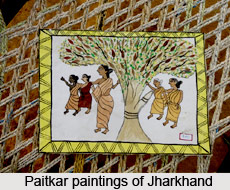
Paitkar Painting
Paitkar painting is one of the most popular and ancient paintings in Jharkhand.
Mysore Painting
Mysore Paintings are the emblems of beauty originating from the classical South Indian paintings.
E-mail this Article | Post a Comment
Forum
Forum on Indian Paintings
Free E-magazine
Subscribe to Free E-Magazine on Art & Culture
 
 
Tyeb Mehta, Indian Painter - Informative & researched article on Tyeb Mehta, Indian Painter
Sitemap
Contact Us   |   RSS Feeds
Copyright © 2008 Jupiter Infomedia Ltd. All rights reserved including the right to reproduce the contents in whole or in part in any form or medium without the express written permission of
Jupiter Infomedia Ltd.